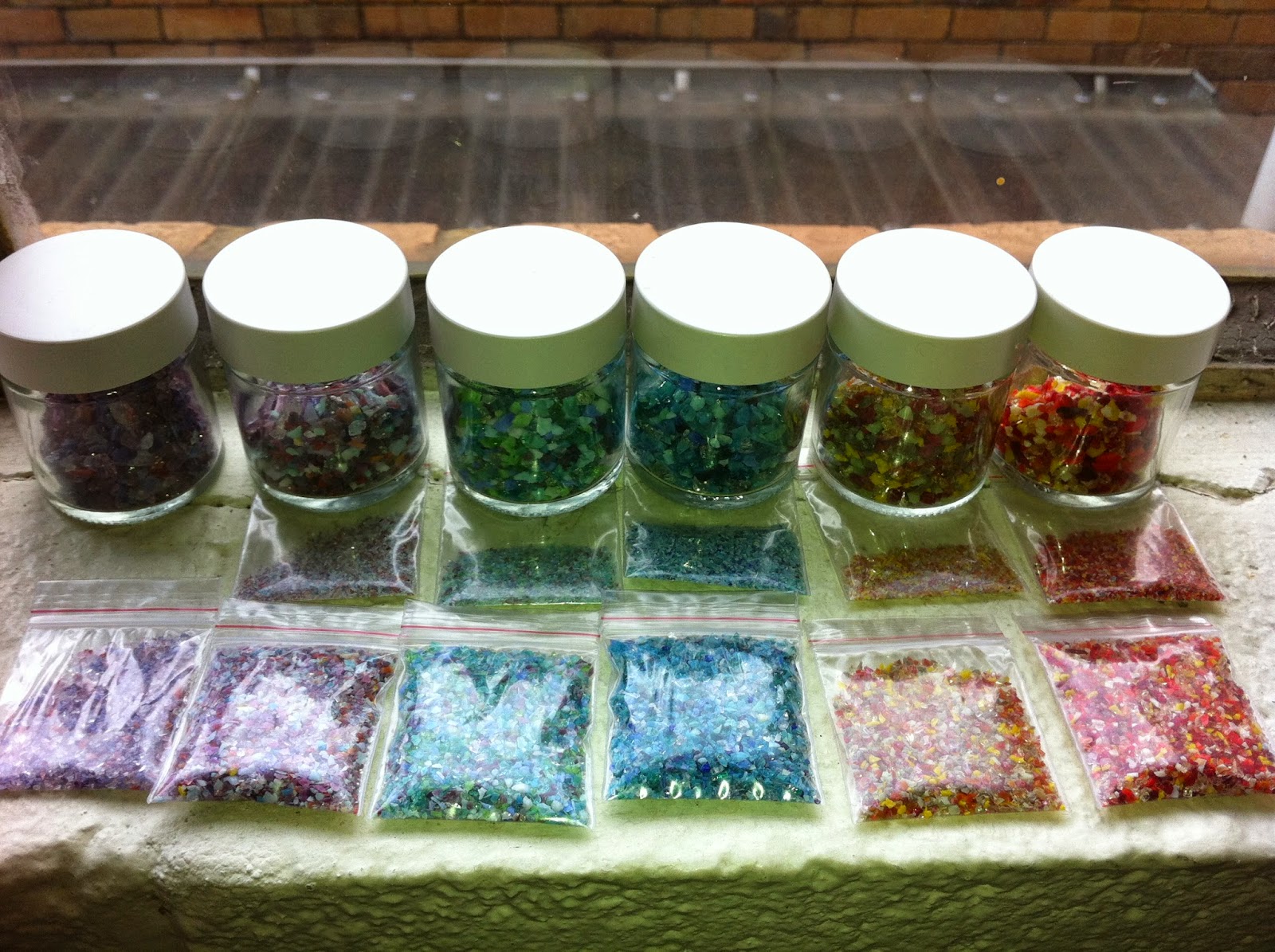
Wednesday, 16 September 2015

Wet Moulds and Bubbles - Kiln Forming Myths 2

Kiln Forming Myths 2

Wet moulds cause bubbles in glass 

This is difficult, as with most myths it is true in some cases and not in others.  The case where it is true is that casting with wet plaster/silica moulds causes water vapour to move toward the glass.  Casting practice has alleviated some of the problem, by having an extended steam out at about 200°C, or pouring the glass into the hot dry mould from a reservoir.

In pate de verre, the mould is most often packed while wet. The small particles allow any steaming of moisture to pass through, and so be dry at forming temperatures without blowing any bubbles.

In kiln forming, the moisture resulting from recently applied kiln wash is considered by some to be a cause of bubbles.  The water in the mould will be evaporated by around 250°C in any sensible slumping programme.  At this temperature the glass will not have begun to move, so the moisture can move out of the mould through any vent holes at the bottom of the mould, or past the glass as it rests on the edge of the mould.

The circumstance when a damp slumping mould could cause difficulties is when using an extremely fast rise of temperature. This is detrimental to the mould, as the rapid formation of steam is more likely to break the mould rather than the glass.  It is also unlikely to result in a good slump conforming to the mould.


Bubbles at the bottom of the glass are much more likely to be the result of too high a process temperature. This allows the glass to slide down the mould.  The glass is not plastic enough to thicken and form a puddle at the bottom at slumping temperatures.  Instead, it begins to be pushed up from the lowest point due to the weight of the glass sliding down the sides.


All myths have an element of truth in them otherwise they would not persist.

They also persist because people listen to the “rules” rather than thinking about the principles and applying them.  It is when you understand the principles that you can successfully break the “rules”.

Wednesday, 9 September 2015

Bubble Formation - Kiln Forming Myths - 1

This short series on the so-called rules of kiln forming looks into their accuracy.

Wet shelves cause bubbles

The common sense observation that water turns to steam as the temperature rises above 100C and so could affect the glass, does not apply in kiln forming (in most cases).

Firing at around 200°C per hour will give approximately 2.5 hours for any moisture to evaporate.  This is because the glass only begins to move after about 540°C. So, unless you have a lot of water in your mould or shelf, the vapour will have disappeared some time before the glass begins to move and conform to the shelf, or round up at the edges.  You may wish to leave the plugs out or crack the lid a little to allow the moisture to escape more easily.

  3.bp.blogspot.com

The holes in this piece result from a combination of factors, not all of which might apply – layup, contaminants on shelf, firing too high or fast, low spots in shelf – but not moisture on shelf.  Note that some of the holes have been filled with frit and refired.


bstiverson.files.wordpress.com

  
These holes are more clearly the result of the layup, top temperature and speed of firing. The three strips did not allow air to move out before the edges conformed to the shelf.  The bubbles at the joints of the dark and yellow green seem to be the result of a poor fit, so having a thin area where the air could push through the softened glass at top temperature.

Two circumstances where this moderate rate of advance does not apply are 

- where extremely fast initial rates of advance, such as in small jewellery scale firings are going to be used. Here the distance for the air or steam to escape is very small so there is little concern about causing bubbles from any cause.


- The other case is in casting, where there is a lot of both free water and chemically bound water in the moulds. Special considerations are required for investment moulds.  In summary, the requirement is to dry the mould in some manner before the firing of the glass on top of, or in it. Plaster moulds require two kinds of water removal.  One is to remove the moisture by air drying in a warm area for a week or longer.  The second is to remove the chemically bound water which is usually done at about 200°C for a couple of hours before proceeding up in temperature.  The length of time required for these two dryings relate to the size of the mould.

For shelves, you can air dry on top of a firing kiln, or fire in the kiln at a rate of about 200°C per hour to 200°C and soak for 10 minutes, if you decide the shelf must be dry before firing.  The plugs should be out, or the door cracked a little to allow the moisture to escape easily. After the soak, just turn the kiln off.  You can open the lid or door if you need a quick cool down.  The shelf will then be ready for a rapid rate of advance firing as there is no moisture to be trapped by the glass conforming to the shelf.  This of course, is rarely necessary although you may be more comfortable in using a pre-fired shelf. 


All myths have an element of truth in them otherwise they would not persist.
They also persist because people listen to the “rules” rather than thinking about the principles and applying them.  It is when you understand the principles that you can successfully break the “rules”.

Wednesday, 2 September 2015

Frit Making with Shock Treatment

Among the many ways of making frit, using thermal shock can be a simple way of producing significant quantities of frit.

The process:

Clean the cullet well.  It is not important to dry it as that will happen in the kiln.  Place the cleaned glass in a stainless steel container.  Take the temperature up to at least 300C as fast as you like – the glass is going to be fractured anyway.


The cullet in stainless steel bowl
360fusionglass.blogspot.co.uk

While the temperature is rising get a bucket or basin of cold water to place very near the opening of the kiln.  When the kiln has reached the temperature, switch off and open the kiln.   Reach in with heat resistant gloves and pull out the container.  Tip all the glass into the water.  It will steam and crackle, but no damage will occur, even to a plastic container.


The heated frit in water
360fusionglass.blogspot.co.uk

When the glass is cool (a few minutes) drain the water off and dry it, either in the kiln or on top or spread out on newspaper.  After the glass has dried you can break it up further with your hands, or any of the other ways of smashing glass into frit.


The fractured glass after drying and before breaking
360fusionglass.blogspot.co.uk

Fritting:

Break up the crazed glass with your usual method of creating frit, and sift it through graded seives  before cleaning any contaminants from the frit.


Cleaning:

My practice is to discard all of the very fine frit and powder resulting from this smashing process, as it is likely to be contaminated with other things, which can give a grey appearance to the work.  

However, you can use strong magnets to remove steel particles from the glass frit and powder.  Some have recommended the use of the magnetic trays used by car mechanics to help remove the steel contaminants. In both cases, the magnets should be covered in plastic to make cleaning of the magnets easier.  You simply take the plastic off the magnet or tray and shake the residue off the plastic, leaving an uncontaminated magnetic surface.

The magnets will not remove non magnetic materials such as a range of stainless steels, and other non ferrous metals. This requires you to use metals that can be magnetised as your breaking implements.  Also, magnets will not remove other non metal contaminants. This means it is important to clean the glass well at the start of the process and keep it clean throughout the breaking process.

Sepetmber 2015, revised March 2026

Wednesday, 26 August 2015

Making Frit

There are many ways of making frit. I have used a variety of instruments to make frit.  I am sure there are many more ways, but these are the ones with which I have experience.

The frit maker can be any of a number of things.


The mortar and pestle is a very good implement for small quantities of frit.  It produces a variety of sizes with little contamination, especially if you use a ceramic set.  You use a grinding motion mainly with occasional thumps.  Cover the open mortar with a cloth to keep the bouncing glass pieces from escaping.


A coffee grinder whether hand cranked or electric is easier.  But it tends to produce one size of frit in small quantities unless you control the grinding to short pulses and frequent sieving.  The other drawback is that the blades of the electric grinders tend to be stainless steel which cannot be removed by magnets. Really thorough cleaning of frit is required.


I have used an adapted kitchen sink waste disposal unit. It produces frit of two sizes – powder and whatever the grid opening is.  The results contain quite a bit of metal and need to be cleaned very well.   The advantage is that it can produce large quantities of frit quickly.


The closed end pipe and plunger is much more work but can produce quantities of varied sizes of frit. It is better to use mild steel rather than stainless steel, as much of stainless is not magnetic, and so the metal fragments cannot be removed in the simplest way.

Shock treatment.  This uses thermal shock of the glass to assist in the frit making process.  It is described elsewhere.


Grading and Cleaning

Sieve all the fines and powder out of the frit and discard.  The metal fragments mixed in these fines can be removed by multiple passes of a strong magnet.  


See here for a method of keeping the magnet clean. However, there are often a number of contaminants that cannot be removed with a magnet.  Washing powdered glass, is a good way to block drains. So the best and safest thing to do is to remove these fines from your frit. A kitchen sieve works well to this.  You can dig this into your garden, as it makes a good soil conditioner, or bag it and put it into the municipal waste.


Grade the remaining frit with a garden riddle or other graduated set of screens.  At this point you may wish to wash your frit to remove any powders from the glass.  Do this in a basin to avoid eventually blocking your drains.  The resulting water can be poured on the garden, or indoor plants.  Alternatively, decant the water from the heavy glass powder and put the damp powder into a sealed bag to protect the refuse workers if you dispose of it in public waste.

You can dry the frit by leaving it in the open air and stirring it occasionally.  You may wish to place some newspaper over the open tray of frit to keep it free of contaminants.  This still has the risk of dust settling onto the frit as this method takes days to dry.  The quicker alternative is to put the glass in flat open metal containers such as baking trays on top of the kiln.  A bit of aluminium foil placed on top of the tray will reduce the dust that can get onto the frit.

Put resulting dried and graded frit in labelled containers for future use.


Wednesday, 19 August 2015

Alternative to Glue

Frit

Yes, clear fine frit can be a risk free alternative to glue.  Glue is to keep things in place while moving to the kiln.  Fine to medium grit can do that too.

Glass is pretty heavy and if you move the piece carefully the frit will not move and its weight will keep the other glass pieces in position.  It is better, of course, if you can build in the kiln.  Then you add the frit at the last moment to keep everything in place during the firing.  At rounded tack fuse the clear glass frit will become part of the surface. 

This method will not work for everything.  If you are using laminating or only softened edges for your tack fusing, the glass frit will remain granular.  If you have to tip or manipulate your shelf into your kiln, this will not work either.

This note indicates the use of frit to stablise stringers and rods.


Using frit to stabilise your pieces is yet another way of reducing the amount of glue usage in your work and so reduce the risk of bubbles and marks, even though the practice is not always applicable.

Wednesday, 12 August 2015

Glass Snagging on Grinder Surface

A number of people report difficulties in sliding the glass along the surface grid.  The glass catches on the grid squares and so does not move easily and smoothly when grinding.
 
homepages.nildram.co.uk


Some suggest sanding the grid to remove any rough places.  The difficulty with sanding the grid is that it will mean that you have to replace the grid before the grinder comes to the end of its life.  Whether you will be able to replace the grid is a risk you have to take if you do this.

It is better to give all sides of your glass a quick arris before beginning to grind. Although technically, an arris is the edge of a piece, it has come to mean the modification of the edge in glass work.

www.pavingxpert.com

 An arris on the glass edges can be made by hand with a pass of a grinding stone on the top and bottom edges.  

www.delphiglass.com

It can also be done by a light pass of the glass along the grinding head. This arris protects your fingers too, as it removes the sharp edges of the glass.

www.ameriglasco.com

Make sure any points on the glass are slightly rounded, as they are most likely to get stuck in the grid.  You can nip the point with your grozers, or give a slight rounding of the point when making the arris.

It is important that you do not press down on the piece of glass. Press horizontally toward the grinder bit instead. The top is plastic and so deforms pretty easily.  With long pieces the bowing of the top means that the glass, which does not bow, will catch on the grid.  So, to keep the surface grid flat, hold long pieces at the ends.  This will remove any tendency to press down in the middle, as any downward pressure will be at the ends of the glass, allowing the grid to remain flat.


Wednesday, 5 August 2015

Channels for Jewellery

One way of providing attachments for chains is to make a channel in the piece. This is most often done by placing something between the glass pieces to maintain an opening for the chain to slide through. The materials can range from toothpicks, coated wire, rolled ceramic fibre paper and many other things which will stand up to the heat for the required time.

One of the requirements is to prevent needle points and drawbacks of the glass. There are a number of ways to do this. Some of them are noted here.

One method is to make pattern bars with a channel through the whole width of the bar. Then you need to cut the bar into strips (leaving the channel material in place), do any edge work required, and fire polish.

When creating a single piece from cut glass parts, you need to ensure the upper piece of glass extends beyond the lower piece by at least 3mm to allow the glass to bend over the channel and touch the lower piece. A little more than 3mm will allow the upper glass to curve over the bottom piece and create a rounded top with no evidence of the joining of the two pieces of glass.

Another method is to use two pieces of 2mm glass with full pieces above and below. The narrowest piece of glass will be about 3-4mm and placed at the top of the pendant. The largest piece will be long enough to give a 2mm gap between the two pieces. This is kept open by inserting two pieces of 1mm fibre paper into the gap. Then cap with the top piece of glass. All the glass can be of 2mm thickness, as the three layers will give the desired 6mm thickness.

Finally, a tack fuse firing can help to avoid the needling that can occur at the channel, as the glass is so much thinner than the 6mm required for a full fuse. This means that you can do the work in stages. First fire the elements to the desired state, then combine them for a tack fuse when creating the channel.


If you use a clear middle glass, you can create a depth by having a design on both the bottom and top layers of glass.

Wednesday, 29 July 2015

Stabilising Stringers

Stringers and rods never seem to stay where you put them.


  • Glue them and they move after the glue has burned away.  
  • Grinding a flat side to them seems a lot of work.  
  • Easier, is to put them in the kiln and take them to a tack fuse to give a flat spot. But that takes a lot of kiln time.
  • For stringers you can put a kink or curve in it by heating over a candle.  Rods require more heat than that. Of course, this is of no use for straight lines, and takes additional time.


A simple method which can be used with a tiny amount of glue, or not, is to sift clear powder around the stringers and rods. A fine film is enough to keep them from moving during the heat up.  Large amounts will give a rough surface or have a greying effect from the multiplicity of tiny bubbles developed between the particles of powder.


Assembled panel by Kathleen Watson with the stringers surrounded with clear powder which can be seen as white

The frit should be put on the assembled panel once it has been moved to and placed in the kiln.  Any movement will disturb the powder and defeat the purpose of keeping the stringer or rod in place.


The fired result

This was fused to a rounded tack fuse and no signs of the clear supporting powder is visible.

This is a quick simple method to stabilise rod, stringer and other small items that may shift in the firing.

Revised 30.7.25

Wednesday, 22 July 2015

Thinning a Melt

There are two basic methods, both use gravity, but one uses additional weight.

Gravity
In this you take advantage of the forces of gravity and the fact that heat reduces the viscosity of glass.  The universal belief is that glass tends towards 6-7mm thick. Yes it does, but only under the times and temperatures we give during fusing.  Those who have seen the results of relay stuck on for hours will know that glass will become thinner than that. A kiln stuck at 1200C for several hours will produce glass that is less than 3mm thick, although stuck to the shelf.

The practical approach is to give the glass plenty of heat work by reducing the usual rate from bubble squeeze to top temperature.  Also increase the top temperature, and give the glass time to flow as it moves slowly.

If your melt is 12mm at the centre and 6mm at the edge you need to take that difference into account when setting the initial rate of advance. A rate of about 90C/hour up to the softening point should be slow enough to avoid thermal shock.  You do not need to hurry from there onwards, because the glass needs to be hot throughout to move easily.  A rate of 200C, or less, per hour would be fast enough.  The top temperature should be set around 810C and for at least half an hour, perhaps an hour depending on the diameter of the piece.  Periodic observation is advisable.  When the reflections seem fairly straight from one edge to the other, it is as flat as it will get using this process.

Anneal for a piece of 12mm, even though the piece is no longer that thickness, because the glass has been through a high temperature process and the compatibility of some of the glasses may be a little less than originally.

Note that this process should be done on a kiln washed shelf.  Thinfire or papyrus will get caught up in the moving glass.  The coarser fibre papers will inhibit the flow of the glass.  You need to expect to do considerable cleaning of the glass afterwards.

Pressing
The other method is to use weight above the glass to thin it more quickly and certainly to the desired thickness.  Place a kiln washed shelf with the kiln wash facing toward the glass.  The weight of the shelf above presses the glass outwards more evenly than a free flow will.

Put solid spacers of the thickness you want the glass to become.  Remember that ceramic fibre used as spacers will thin when the binder has burned away. So, a 6mm stack of ceramic fibre paper will be less than that at the end of the firing.  The larger the pieces of fibre paper you can use, the less the effect will be, as the weight of the shelf will be distributed over a wider area. 

The same kind of firing schedule can be used on the way up as in the gravity only method, but you need to approach the annealing differently.  With two shelves and the glass between, you should be thinking of annealing for something in the region of 25mm. 


Do not do this pressing on top of your normal shelf, as the temperature differential between the exposed shelf and the part of the shelf covered with 12mm of glass and 15mm of shelf will be pretty large, leading to thermal shocking of the shelf. 

Wednesday, 15 July 2015

Lead Free Solder

Lead free solder is being required for the electronics industry, but not yet for the stained glass industry.  However, some people are beginning to use lead-free solders for other reasons.  In general, it is reported that it is harder to get smooth beads.  Some reasons may relate to the physical properties of the material being used.

Lead free solder solidifies at a higher temperature than the common tin/lead solder compositions although the common lead free solders melt at slightly lower temperatures.  For comparison purposes characteristics of some common lead free solders are given with the common tin/lead solders.

Sn = Tin,   Ag = Silver,   Cu = Copper   Pb = Lead
Solidus = solidification temperature.   Liquidus = Melting temperature

96%Sn, 4%Ag which has a Solidus of 221C and Liquidus of 229C
95%Sn, 5%Ag which has a Solidus of 221C and Liquidus of 254C

Slightly less commons is
96.5%Sn, 3.5%Ag which has a Solidus of 221C and Liquidus of 221C, but has poor wetting properties except on stainless steel.

Other solders are available up to 7% silver, but these are increasingly expensive and have much higher liquidus points.

A truly eutectic lead free solder can be produced with 95.6%Sn, 3.5%Ag, and 0.9Cu, which has a Solidus and Liquidus temperature of 217C

For comparison:
63%Sn, 37%Pb has a has a Solidus of 183C and Liquidus of 183C
60%Sn, 40%Pb has a has a Solidus of 183C and Liquidus of 188C
50%Sn, 50%Pb has a has a Solidus of 183C and Liquidus of 212C
40%Sn, 60%Pb has a has a Solidus of 183C and Liquidus of 238C

The solidus temperature of lead free solders is almost 40C above the tin/lead solders.  This may be the reason people find the need to turn up the heat of their soldering iron when using lead free solders.  The difference in the Liquidus and Solidus points for 4%Ag is very similar to that for 60%Sn/40%Pb.  So with enough heat should behave similarly.