Tuesday, 10 January 2012

Light Box

Light boxes are in many ways a development from the glass easel. These were used in studios to wax up the painted glass and display it as it would be seen in a window. Sometimes the glass painters painted across all the glass at once, so this method enabled them to see the results immediately.


Nowadays people tend to use back lighting for these and other purposes, so the light box has become more popular. Some of the uses are outlined here:

The light box is very useful when tracing or altering designs. The back lighting enables you to use other paper than tracing papers to transfer the design elements. You can fold the paper along the lines of symmetry to check on how the lines match, or to copy the lines from one side onto the other side at the designing and cartoon stages.

The light box can help select glass colours either initially or when the main pieces have already been established. The combination of the glass over light shows how they interact with each other. At later stages when the main glass is cut, it can help avoid unwanted bright or dull areas.

Possibly the most common use is in cutting dark or opalescent glass. The additional light allows you to see the cartoon through the glass and so cut directly from the cartoon. This can be enhanced by blanking out the excess light from around the glass or cartoon.

The light box enables the arrangement of the cut glass pieces to be assembled to view the colour balance and have a virtual view of how the panel or window will look as a finished piece. An additional step toward the result is gained if each piece is outlined in white-board markers – use black pens - to represent the lead or copper foil and their widths. This stops the light between the pieces from causing you pupils to contract, and gives a more accurate representation of the appearance of the final pane.  White-board markers can just be wiped off the glass without using spirits.

The light box is important in painting. The back lighting shows the effect of the painted line or level of shading immediately. This allows adjustments to be made quickly and accurately before firing,

Depending on how the light box is built, it also can be used as display lighting. This can be as up-lighting or backlighting.

Additional notes:
Light box requirements
Flexibility
Top surfaces
Lighting

Thursday, 5 January 2012

Paper

The traditional approach to cartoons meant three versions were necessary. One with all the drawing details, one with the cut lines, and one for layout and leading.

If you are doing a leaded or copper foiled panel without details for painting on glass two copies are the maximum required. I make do with one original, as I have no place to keep the glass pieces laid out while cutting and beginning to lead, nor do I make templates for cutting.

The paper you need is one that is stiff enough to avoid changes in shape or wrinkling with changes in humidity. The paper also has to be robust enough to stand up to lots of movement. Cartridge paper from a roll works well, but is often seen as expensive. Brown wrapping paper is usually stiff enough, although thinner than cartridge paper.

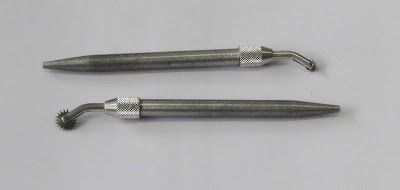
Tracing paper is very useful, if you do not have a light box, as you can trace details from one version of a cartoon – whether new or from an old one – into another. However it changes shape when exposed to high humidity. To transfer the cartoon to more stable or more opaque paper, you can use a pounce wheel to transfer through the tracing paper for the final cartoon.

Two pounce wheels

If you have a light box you can use it to make the transfer, or you can stand at a window with the two sheets of paper taped together to trace the design onto the final cartoon paper.

If you need to make pattern pieces you will need a second copy to cut up. Here you need paper or card that lies flat. You may also find it useful to cover the main cartoon with a water proof covering if you are going to do a lot of grinding and fitting over the cartoon. You can do this by oiling your paper (as for stencils) or by sticking clear vinyl over the cartoon.

Friday, 30 December 2011

Soldering Radiating Lines

Some times no matter how you try to avoid it in the design, you end up with multiple solder lines joining at one point.

In copper foil work, I find it best to tin all the copper foil before assembly, as this means you can use a minimum of solder to tack solder the pieces to one another.

You will be left with less solder at the joint if you start from the joint and move away from it while soldering. This drags the solder into the bead line rather than letting the solder build up at the joint of the multiple lines and give a resulting high point resulting from the accumulation of solder there.


Monday, 26 December 2011

Kiln Furniture

You do not have to buy all your kiln furniture. Any refractory material – any heat resistant material that will stand up to the forming temperatures – that you have from broken shelves or used material will do.
The advantage to home made kiln furniture is that you can have exactly the shape you want. There are a number of possibilities.


Example of broken shelves

 Broken kiln shelves can provide supports and dams. They can be cut with a tile saw to give long strips that can be used as dams. Smaller squares and rectangles can be stacked to give height to other supports for the glass.

Cutting a shelf with a hand saw
25mm vermiculite board

Vermiculite in the form of a pressed board provides a medium strength kiln furniture. It can be cut with a wood saw, although it dulls cutting tools quickly. The board can also be carved with wood working tools although it is very abrasive, requiring tools to be sharpened before use on wood again.

25mm ceramic fibre board

Fibre board is not as strong or rigid as kiln shelves and vermiculite are, but is much more adaptable to curves and undulations. They can be cut with a knife and used with or without hardener – colloidal silica. If the hardener is used some kind of separator will be required to keep the glass from sticking. Dust masks are required for working with ceramic fibres.


Soft fire brick

Soft fire brick can be cut with a hand saw into many shapes and and sizes. They are suitable as supports and braces for dams.  There are also higher density bricks that are much heavier to resist the movement of dams.


3mm fibre paper

Fibre paper can be cut and stacked to provide shims to level shelves and moulds. Shapes can be cut into stacked layers of the material to provide dams for irregular shaped projects.

Thursday, 15 December 2011

Uneven Slumps

Uneven slumps are an occasional feature of kiln forming. There are a number of possibilities that can cause this.
A mould that is not level will lead to an asymmetrical slump. You need to make sure on each firing that the mould is level, as well as your kiln and the shelf or supports. A three-way level can check this quickly.
Glass that is placed unevenly on the mould can cause uneven slumps. The glass should be placed on the mould so that it is equidistant from the edges of the mould all the way around. The glass needs to be level too. Again the three way level can help.

A slight bevel on the bottom edge can help avoid any catching of the glass as it moves within the mould.
Baffling or shielding parts of the glass can keep the heat off areas that tend to heat up faster than the rest and so begin moving before other parts of the blank.

Deep moulds most often present difficulties with uneven slumping. The best approach here is to use multiple, progressively deep slumps.

It also is possible to reach in with a wet stick and move the glass back to an even slump during the firing. Please observe all the safety requirements.

Most importantly, slow temperature rises solve most of the problems of uneven slumps. Fast temperature rises allow the component parts of the piece to absorb heat differently for different colours and glass of different viscosities. Slow rises in temperature help avoid any unevenness in the way the kiln heats the piece. Slow rises give more control and achieve the result at a lower temperature.

Note that a number of the solutions require observation while firing. The best results come from observing what is happening in the kiln. It allows you to make corrections either while firing, or – more often – in the next firing of a similar project.


Saturday, 10 December 2011

Leaking Cutters


People sometimes comment that their cutters are leaking. Most cutters of the pencil type are not prone to leaking. Some of the pistol shaped cutters seem to have more difficulty.
One possibility is that the oil being used is too thin for the system that dispenses the oil. In that case a little thicker oil may cure the problem.

It may be that the oil is leaking from some where else than the valve or wick that is intended to dispense the oil. This sometimes happens when excessive pressure has been put on plastic handled cutters whether pencil or pistol. In this case, the alternative is to replace the cutter or use another method.

The other method could be called the dip and cut method. In this case you leave the reservoir empty and have a shallow container filled with oil soaked cotton wool. Dip the cutter wheel into the cotton wool before each cut and this will give you enough lubrication for the score. A variation on this is to dip a brush in a container of oil or turpentine substitute and paint along the line of the cut before scoring. Both are effective.

Although it is not a repair, you can push a cotton wool lump down to the valve or wick, saturate it with oil and then there is enough oil to lubricate the cutter wheel, without an excess to leak out. You do need to renew the oil for the lump of cotton wool from time to time.

Monday, 5 December 2011

Reworking Designs

Principles of design practice for stained glass, 5

Having created the design, you should consider re-working the designs for a variety of reasons. Some of these are:

- to save time in the later stages of the work. It all too easy in the excitement of creating a new piece to want to get directly on with making, however this often gives construction or design difficulties that have to be solved in the making, leading to compromises. In general far too little time is spent in the design stage. Time spent on the design will be more than saved in the construction and will produce a more satisfactory piece.

- to ensure the structural stability of the piece. Although reinforcement should be considered from the beginning of the design, this is the time to ensure that the piece will stand up to the use it will receive during its – expected – long life.

- Make sure you have investigated every possibility to answer the challenges of your design.

There are a number of activities that can help with these elements.

Reworking will enable you to maintain the essence of the design while simplifying lines and easing the labour of the construction of the panel. Often the design contains a number of lines that are not essential to the whole design.

As you re-work the design, you can make sure every curve, dip and angle are to your liking and so improve the whole. Redrawing also helps understanding of the design and the placing of lines. It will also help in considering the placement of lead came and the widths to be used.

Make sure the design is still structurally sound. The design should avoid long nearly straight lines with few interruptions, especially those that go from edge to edge in any direction. The lines should interlock rather than have many joins onto long lines.

It gives an opportunity to ensure that you can cut all the pieces. This is the time to look at the negative or background pieces to make sure you can cut them as well as the foreground pieces. Usually people are so concentrated on designing the main image that the background becomes too complicated to cut easily.

Make successive tracings with each change, so there is a record, allowing you to step back wards to an earlier version if necessary.

If this re-working stage leads to the realisation of design problems, there are some things that can be tried:
  • Cropping the design can transform it. The focus of the design can be enhanced by removing some of the surrounding “information”. The change of proportions say from landscape to portrait can make significant differences.
  • Enlarging and using only a portion of the original design can be a solution. This is similar to the cropping operation, but has the added advantage of making the pieces larger and easier to cut.
  • Further simplification of background design lines can be considered. This will bring the focus back onto the main part of the image.
  • Changing relative proportions can transform the design, e.g., by enlarging a busy background, it can be made simpler and easier to read the whole panel.
Elements of Design:

Wednesday, 30 November 2011

Design Sources

Principles of design practice for stained glass, 4

Use the everyday visual experience and make interpretations and adaptations. E.g.,
  • draw lead lines on an illustration to make it suitable for stained glass, using the fewest lines possible
  • Use your photographs of interesting subjects and scenes
These may never become useable designs or cartoons, but will increase you abilities to design from the real world toward the abstract.

Make and keep sketches as personal references. These do not need to be finished drawings, just a reminder of the thing(s) that caught your eye. Many artists always carry around a notebook to record these observations. Even if you only make drawings on paper napkins, make a folder to keep these separate sketches together.

Take photos of shapes and interesting images. These can then be used later to develop images.

Make up composite images by using overlays or collage. This helps develop your compositional abilities.

Work on abstraction in your design practice:
  • Study abstract representations. Dissect – decomposition is a popular word - and analyse how the work is put together.
  • Use geometric design as an introduction to abstract design. This forces your attention to structure, balance and colour.
  • Once the distribution of the physical and visual weights is understood, this enables the jump to more free forms of abstraction.

Friday, 25 November 2011

Beautiful Design Lines

Principles of design practice for stained glass, 3

Stained glass is a graphic medium where line and colour are very important. Achieving pleasing lines and forms requires practice and use of various approaches and techniques.

The two dimensional world is one of abstract thought. Work and development are the way to creativity – there is no mystical talent. Practice drawing every day – set aside time to do it, if you normally shy away from drawing as an exercise.

Study and learn from what has gone before. Look at the images and objects you admire and analyse what you like about them and why. Also consider what things could have been done differently. Consider how those changes would affect the character of the piece.

Of course, maintaining your creative attention is difficult, so when blocks occur try some or all of these things:
  • Put the work aside for a day or two before taking it out and looking at it again.
  • Alternatively, pin up the design on a wall where you can look at as you pass by. When you see a change to be made, do it immediately and pin it back up.
  • Get a new perspective, e.g.:
    • Turn it upside down. This will enable you to observe differences and spot inconsistencies
    • Look at it in a mirror. You might see people studying still life or live subjects together with their drawing in a hand mirror to get a new perspective that will help spot difficulties.
    • Put the design on the floor and climb a ladder to look at it. This provides distance and changes the angle at which you look at your design.

Remember that design tends toward realism or abstraction. You need to work on both forms, remembering that glass is a graphic medium that tends toward abstraction. Working on both forms develops your flexibility and knowledge. Having a working knowledge of both enables you to have a responsive approach to the client.

Sunday, 20 November 2011

Responsive Colour Selection

Principles of design practice for stained glass, 2

The graphic form of much stained glass means that the medium is about line and colour. This requires that you think about both your and the viewer's response to the colour combinations. Respond to your instincts. Use you feelings about colour and their relationships. Try different colour ways. Formal training does help, but experience develops your skills. The individuality of the piece depends on the use of your instincts about the colour. There are some checks you can make while selecting colours.

Think of colour and impact. Hot colours tend to have more impact, as they give bright points or areas. Impact can also be created by using non-complementary colours together. If a more subtle impression is desired, use tonal variations without great contrasts.

Vary areas of colour and their proportions. This provides interest to a panel. It avoids a mechanical symmetrical appearance, even if the design is symmetrical

Think about colour balance. Although the colours may vary it is important that the weights of the colours are balanced so that the focus of the panel is not taken to another part because of the imbalance of the colour with the design.

When you are in difficulty selecting or arranging the colour, step back and view from a distance. This is one of several techniques to enable you to get a larger or different view. Others include viewing the design through a mirror, viewing through half closed eyes, look at the design from the other end, and viewing the design from acute angles.

When something feels wrong, trust your intuition and use other colours. Colour theory is just that -theory. It is through using your reactions that the piece becomes individual.

Seek out the nuances of the glass in tones and textures. These alter the perceived colour and weight considerably.

Keep the design lines simple when your emphasis is on colour, light and texture. This allows those qualities to dominate the panel, rather than the lines.

Always make a coloured drawing, before choosing the glass, as a reference. This is a rendering of your original idea. It provides a reference as you select the colours. It is something that can be altered, of course, but does provide an essential reference point.

Choose glass colours in the kind of light for which the panel is intended. This is essential, as the glass colour is subtly different in daylight, incandescent, and fluorescent lights.


Elements of Design: