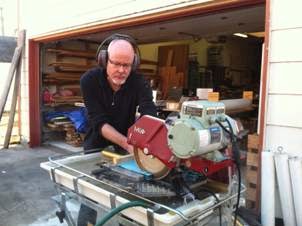
Wednesday, 3 June 2015

Flattening a Distorted Piece

It is sometimes possible to flatten a formed piece to once again fire it in a mould.  A lot depends on the shape of the mould it was first fired in. A mould which requires a lot of stretching or has sharp angles is likely to produce a flattened piece of glass that will have extensive distortion of the pattern or design of the original piece.

A full fuse is not necessary.  The object is to make the shaped piece flat.  That should happen at slumping temperatures and certainly long before a full fuse.  A tack fuse temperature may even be more than required. 

You will need to observe the firing, to ensure that you get the piece flat but do not further distort it. Set the schedule for the temperature you think will do the job. Then add some soak time. Observe with quick peeks from about 50C below your target temperature. This will give you the information you need for this one and future pieces.


When the flattened shape is achieved, advance the controller to the next segment and anneal as before.  When cool, wash and inspect the piece for a clean surface without any imbedded kiln wash or fibre paper.  Consider whether this flat piece still has a desirable design, or is too badly distorted.   It may be that you want to slump the piece even if the design is distorted as a learning experience.  

Wednesday, 27 May 2015

Float Glass

A question about sharp raised points on the corners of a square bubble plate made of window glass is the occasion to discuss some characteristics of float glass. 

It is necessary with float to find out which is the tin side and which is the air side. The tin layer of the glass produces a bloom that resembles devitrification when compressed. Put the tin side down for a slump.  If you slump with the tin side up, you will create a tin bloom by compressing the tin. If the tin is on the bottom, you will be stretching the tin and so avoid the tin bloom.

S
harp, pointed and raised corners are the result of devitrification.  Devitrification is the crystallisation of glass. Mild devitrification appears to be dirty streaks across the surface. Extreme devitrification produces a crumbling glass surface. Raised, sharp corners are the result of intermediate devitrification. The tin side does not protect against devitrification.  It does provide a separating action when against the shelf, although kiln wash is still needed.  Float glass devitrifies easily. I have only ever been able to get two firings without devitrification.

Cleaning is of great importance in avoiding devitrification. Clean well with only a little detergent, rinse and then polish dry with paper towels. Any residues left on the surface will promote devitrification.

A general way of reducing sharp corners is to nip or round the corners with diamond pads. I nip the corners - it is quicker and does not leave any microscopic pits for devitrification formation.

Paint, stains and enamels will interact with the tin to produce variants of the colours.  Stains most often become darker than when put on the air side. Powder, frit and mica will not usually react to the tin.


Remember, float glass is not manufactured to be a kiln forming glass.  You will always be at risk of devitrification.

Wednesday, 20 May 2015

Firing Quickly

Firing quickly is often our desire, in spite of the mantra of the experienced – slow and low. How to do this safely – without fractures or bubbles – is the requirement.

Firing quickly on smaller things (say, up to 100 mm) is not normally a problem.  Difficulties can arise due to the kind of layup, but usually the mass is not great enough to be thermally shocked, nor the size enough to trap air that would cause bubbles.

Firing quickly for larger pieces is where difficulties arise. These relate to the initial rate of advance to the softening point, the bubble squeeze, advance to top temperature, and annealing.

Advance to softening point
The first place this occurs is to the upper strain or softening point.  This is the range where the glass is solid and does not transmit heat well, leading to the risk of thermal shock.  You need to find a rate of advance that is a little slower than that which would cause the glass to break.  My guidance is to use no more than three times the annealing rate for the glass of that thickness to reach the softening point.  This temperature is approximately 40C above the annealing point. The glass is certainly plastic above that temperature, so the rate of advance can be faster.

Bubble squeeze
Strategies from the softening point to bubble squeeze vary.  You can go quickly, say 1.5 times the previous rate of advance, to the bubble squeeze heat soak of around 30 minutes.  The other is to go quickly to 50C below that temperature and advance at 50C per hour to the bubble squeeze heat soak.  This is often used on more complex and thicker lay ups. There are numerous variations upon these two strategies depending on the circumstances.

Top temperature
Ways to get to top temperature from the bubble squeeze vary, but as fast as possible risks bubbles due to excessive softening the surface, over firing due to the controller not shutting off quickly enough, and a lack of control of the surface texture.  Twice the initial rate of advance is quick enough, but still allowing the controller to shut off when the top temperature is being reached.

The s
oak at top temperature does not need to be more than 10 minutes.  If you can achieve the desired results in less that time, you should consider reducing your top temperature.

Annealing cool
A s
oak at the bottom end of the annealing range will reduce the anneal cooling time.  The lower temperature of the annealing range is about 40C below the annealing point, so to be safe the annealing soak can be set to be 30C below the annealing temperature.  This reduces the range of temperature over which the slow anneal cool takes place. 

The initial anneal cool should be to 55C below the soak, the second stage of the anneal cool to 110C below the soak can be at twice the initial anneal cool rate.  The rate of cool can be increased to 370C, where for pieces of 9mm or less, the kiln can be turned off.


However, you need to think carefully about firing quickly.  When realistically will you be able or actually need to take the piece out of the kiln?  If it is the next day or after work, then a slower firing reduces the risks of rapid firing and still enables you to take the piece out when needed.

Wednesday, 13 May 2015

Frit Making

Start with clean cullet. Rinse or wash off all the dust and felt tip marks. Spread out to dry, or put the collection in the kiln at about 200C to dry.
  

An example of clear glass cullet


It is possible to start with the dry glass, or you can heat the glass to a temperature in the 300C to 450C range in a stainless steel container.  Then take the hot container with heat resistant gloves and pour the hot glass into a bucket of water (do not pour the water onto the glass, as a great deal of steam will be produced burning you).  The fractured glass can then be further broken down in size after being dried.

Smashing the glass can be done in a number of ways.  A small amount can be made in a mortar and pestle.  Larger amounts can be put between sheets of newspaper, in plastic bags or any other container that will keep the glass from shooting all over.  Hit the glass package with a hammer multiple times.

You can build a frit maker from pipes with end caps.  Fit one pipe inside the other with the glass between the ends and pound the glass between the two surfaces.  There are a number of variations on this method of production.

An example of  a commercially available frit maker


Large scale frit production can use coffee grinders, or adapted waste disposal units. Waste disposal units tend to produce a lot of frit of the same size, while coffee grinders with blades produce frit sizes related to the time the glass is ground.

Example of a suitable coffee grinder

Example of a garbage disposal unit


When you have created a pile of frit, sieve it into various sizes with screens.  It is best to discard the fine frit and powder, as they contain contaminants that are difficult to clean out and will discolour the finished product.

Example of a commercially available set of seives


You also need to ensure the metal is removed from the glass by using a strong magnet.  Fridge magnets will not do.  Put the magnet in a plastic bag and run it over the frit several times.  When finished take the bagged magnet to the waste bin and remove the magnet.  The metal will fall into the bin.

Example of  a pair of strong magnets


It is a good idea to rinse the remaining frit to remove dusts and ensure the frit is clean.  Again you can put the frit on a metal tray in the kiln to dry.  Put the frit into a closed container to keep it clean until needed for use.

Wednesday, 6 May 2015

Fibre Board Moulds

There are a lot of moulds available in a variety of shapes and sizes through various suppliers.  But sometimes you want a simple or special shape that is not available to buy.  Fibre boards provide you with the material to make your own special moulds without great expense.

The ceramic fibre boards tend to come in a variety of thicknesses, mostly about 1 metre square.  Boards in 10, 15 and 25 mm thicknesses are commonly available. 


You should work in a well-ventilated area using a dust mask to avoid inhaling the dust and fibres.  See Gregorie's Glass for information on safety.

You can cut a wide variety of shapes into fibre board with just a craft knife.  You can smooth the shapes with just sandpaper. The shape can be smoothed with sandpapers in both natural and hardened states.  If a lot of material is taken off hardened shapes, it is advisable to coat that area with hardener and cure it again to ensure maximum durability.

A question that will arise is whether to harden or not.  This depends on the durability you require.  A board that is not hardened does not require kiln wash when fired.  However, as it is soft it is easy to break.  A hardened fibre board mould always requires kiln wash or other separator.  It does become durable and almost rings when tapped once it is hardened and cured.  If the shape needs to be preserved for further use, hardening is advisable.

It is also possible to stack the boards to make deeper forms.  The boards should be stacked and pined together with copper of high temperature wire such as kanthal to keep them from moving both while shaping and in use.


Fibre boards are relatively inexpensive, in comparison with commercial moulds.  They are not as durable as some, but provide a means of obtaining special shapes unique to your work.

Wednesday, 29 April 2015

Large Bubbles

cambridgecreativenetwork.co.uk
Some times you want large bubbles, but when you don't, you need to know about the causes of, and ways to prevent, bubbles.

Causes and prevention of most large bubbles relate to volume control, layup, rate of advance and top temperature.

Volume control. We all know that glass tends toward being 6-7mm thick at full fuse temperatures. Any less volume and the glass thickens at the edges, so trapping air under the glass which will push up and through given enough time and temperature.

Layup. The lack of volume control is compounded by layups which do not allow the air to escape from under the edges of the piece.

Rate of advance. These two problems are compounded by asap, or even just rapid, increases in temperature. The glass softens quickly and the air finds it easier to push the glass up than to escape from under the edges. Slowing down is part of the answer.

Top temperature. A high top temperature softens the glass to the extent that any lack in volume control, layups that have hollows or traps for air, and rapid increases in temperature all allow the expanding air (and there will always be some) underneath the glass to push up and often through the glass.

These factors reinforce the Low and Slow mantra.

Other factors can promote bubbles, although the ones above are the most common. Debris between the glass and the shelf, or between glass layers can cause bubbles, given the right conditions. Small shallow indentations in the shelf can be the source of bubbles from underneath the glass. This can be identified by observing where the bubbles occur in relation to the shelf.

There are some things that can be done to reduce the likelihood of bubbles:


Wednesday, 15 April 2015

Dams for Melts

There are a number of commercial moulds, dams and rings to contain pot and screen melts.

You can, of course, make your own. A simple one is to use 10 or 15 mm fibre board to contain your pot or screen melts. Cut the size and shape of hole you want into the board and that will contain the glass.


You can place this directly onto the kiln washed shelf. No fibre paper is absolutely required unless you want to. You can weight the board by placing the supports for the screen or post directly onto the board.


If you want to use the board more than once, you need to harden it with colloidal silica and fire it. Then you always need to put a separator on it at each firing to ensure it does not stick to the glass melt.


This process allows you to make custom shapes and sizes without great expense. With a bit of ingenuity, you can provide your own textured bottom to the melt.


Wednesday, 8 April 2015

Safe Cooling Speeds


Almost everywhere you read that you should not open your kiln to cool it. But we know that the kiln cools progressively slower as it nears room temperatures. So how do we safely cool the kiln at rates the glass can cope with.

www.poolspanews.com

Some advocate directing a fan at the closed kiln on the grounds that air movement will cool the kiln faster than still air will. Yes, but at a negligible rate due to the insulation properties of the the kiln.

It is much safer to program a sensible cooling rate all the way to room temperature from 370C/700F. This allows you to open any viewing ports knowing that any too rapid cooling will be counteracted by the controller switching on the heat. Upon hearing that power input, you can close the ports partially until the kiln cools a bit more.

www.woodstove-fireplaceglass.com

At lower temperatures, you can open the lid or door. The controller will operate as before warning you of too rapid cooling, so you can reduce the opening until more air is required.

Wednesday, 1 April 2015

Clay Moulds

Making your own clay moulds is not as difficult as often imagined. You do need to have access to a kiln that can fire to bisque temperatures, as they are above the usual limitations of glass kilns.

There are a variety of clays you can use – paper clay, school clay or any cheap clay from a ceramics supplier. Make sure any “clay” you buy from craft shops is in fact ceramic clay and not one of the no-fire or oven fire “clays”.

The method for slab moulds is fairly simple. You need to roll out a sheet of even thickness. To do this there are a few items required.
  • Board to support the rolling of the clay
  • Rolling pin of sufficient length
  • Cloth for the bottom of the clay
  • Battens of 8-10 mm thick

cdn.instructables.com

Place the smoothed cloth on the board.
Place or fix the battens to the width needed.
Put the clay onto the cloth and work it out to the approximate thickness you require by hand.

Use the rolling pin to complete the process by pushing the clay in front of the rotating pin to get an even thickness. This will require a number of passes, both away from and toward you. You can patch any shallow places by simply putting a small piece of clay there and going over it with the rolling pin.

At this point you can impress any design you like on the wet clay, or you can incise the leather-hard clay later.

www.amaco.com


If you are shaping the clay, you can use a variety of materials to hold the clay in the shape you want. You can use another form to support the whole of the clay if desired.

bluewillowstudio.net


Set the clay aside to dry, ideally where air can get to all sides/surfaces. The clay will shrink during this drying process. It will take longer to dry if the clay can dry from only one surface, and it is more likely to crack. So if only one surface can be exposed to the air, you should cover the whole piece with a damp cloth to slow the evaporation from the top surface.

When the clay is leather hard, you can sand or mark the clay. Then have the clay fired to bisque temperatures. When you get the fired form back, you should sand any roughness away, as this will be the bottom surface of your completed piece.


It is important that you kiln wash or provide other separators between the mould and the glass, as the clay and glass will stick together. Because the clay and glass expand and contract at different rates, the glass will be broken or crazed by the ceramic.

Wednesday, 25 March 2015

Straight Edges on Thick Pieces

As glass tends towards 7mm at full fuse, it is difficult to keep straight edges on thick pieces as the glass moves. If you want straight edges without dams, there are a few solutions:

1) Don't flat-fuse - apply less heat work so that the stack stays vertical instead of spreading. The degree of tack fuse required will be a subject of observation and experimentation.

cdn.supadupa.me

2) Plan on trimming the edges straight. You can use a saw or grinder and then either cold work the edges to polish, or fire polish.

fusedglass.org


3) Add a couple of centimetres or so on each side of your base glass, so that a 20x20cm piece becomes 24x24cm, and flat-fuse as normal. The volume change will (mostly) be absorbed by the extra glass, so that you can simply trim it back to the right size and cold work the cut edges.


artgroupsdfw.com