Wednesday, 28 May 2025

Firing silicone mastic

Several people have asked over time about the consequences of firing glass with some silicone mastic (or caulking) still attached to the glass. 

I can say with confidence that it does not break the glass.

I can also say, that it really is not a good idea.  Take as much as possible off with knives, then use silicone disolvers to remove the remainder.  These photos show the results of firing silicone residue.


Where there were pieces of silicone, a divot appeared with the black combustion product from the mastic/caulking.  Where there were strips of silicone, a small valley occurred.  The smallest amount of silicone appeared as a dark divot in the glass.  

It is possible to remove the silicone residue with sandblasting.  Other abrasive methods are possible, but much more time consuming.   Once the silicone has been sandblasted away, the glass needs to be cleaned of all the dusts, and covered with a fine layer of fine frit, or if prefered, powder.  But I find fine frit works better, although it requires a full fuse to form a smooth surface.


Wednesday, 21 May 2025

Glass Frit Seals for Microelectronics

 Glass frit sealing technology provides a superior solution for achieving reliable hermetic seals in precise applications like micro electromechanical systems manufacturing and packaging.

Image credit: Mo-Sci, Llc


Wednesday, 14 May 2025

Draping over steep moulds

 Draping over a narrow or small supporting ridge with large areas of glass is difficult.


One solution might be just to invert the whole piece and let the glass slide down into the mould. However, there rarely is enough height in a glass kiln for deep slumps, especially with a “V” shaped mould. It has to be high enough for the edges of the glass to be supported at its edges. You could also approach this by having a first mould with a shallower angle or broader support at its centre. Drape over this first, then use the steeper mould as the second draping mould. This makes the balance less critical.


The idea of supporting the glass is the key to doing this kind of slump that seems to require an impossible balancing act, if it is to be done in one go. Place kiln washed kiln furniture at the edges of the otherwise unsupported glass. Fire the kiln, but watch until the glass begins to slump. Then reach in with a wet stick and knock the kiln furniture aside to allow the glass to continue its slump and conform to the mould shape.


The lower temperature you use to do the draping and the slower your rate of increase is, the less the glass will be less marked by the mould. Frequent brief visual inspection during the drape is vital.


Also have a look at a suggestion for the kind of firing required for this here.

Wednesday, 7 May 2025

Radiation Shields

 Glass has a use as a radiation shield in medicine, industry, and aerospace.

Image credit: Mo-Sci,Llc


Wednesday, 30 April 2025

Using Ceramic to Drape

Characteristics

Before choosing a ceramic shape to use in draping of glass, you need to consider the characteristics of the two materials.  This is one circumstance where CoE is actually useful. 

The expansion of the two materials is different. 
  • Soda lime glass typically has an expansion rate - in the 0°C to 300°C range - of 81 to 104.  
  • Ceramic has an expansion rate - in the 0°C to 400°C range - of 30 to 64.  
This is important in the final cooling of the project.  As the glass expands more than the ceramic on the heat-up, so it also contracts more during the cool.  This means that the glass will shrink enough to trap the ceramic or even break if the stress on the glass is too much. 


Shape

The shape of the ceramic form will have a big effect on the usability of it as a mould.  Ceramics with right angles between the flat surface and the sides will not be suitable for draping without modifications or cushioning.  The forms suitable for draping need to have a significant draft to work well.

Ceramic forms such as rectangles, cubes, and cylinders do not have any draft in their form.  
A cube shape unsuitable for draping

Ceramic cylinders with straight sides

Although rounded at the base, the sides are too straight to be a draping mould


The glass will contract around these forms until they are stuck to the ceramic or break from the force of the contraction around the ceramic.

You can experience this trapping effect in a stack of drinking glasses.  Sometimes one glass sticks inside another even though there is a slope (i.e., a draft) on the sides of the glasses. This happens mostly when you put a cold glass inside a warm one.  On cooling the warm glass contracts to trap the cooler one. You can separate these by running hot water on the bottom glass, so that it expands and releases the inner, now cool, one. 


Effect of Shape

The ceramic contracts at about half the rate the glass contracts (on average), unlike steel which contracts faster than the glass. This means steel contracts away from the glass, while the glass contracts against the ceramic, on the cooling.

Because the glass is in its brittle or solid phase during the last 300°C to 400°C, this contraction tightens the glass against the ceramic, causing stress in the glass, even to the point of breaking.

However, if you choose ceramic forms with significant draft, you can drape over ceramic.  This is possible when the slope is great enough and the form is coated with enough separator, to allow the glass to slip upwards as it contracts more than the form. Experience with different draft forms will give you a feel for the degree of slope required. 
 
These pyramid shapes have sufficient draft to allow the glass to move up the mould during cooling.


Compensation for Lack of Draft

You can compensate for the insufficient draft of ceramic forms by increasing the thickness of the separators for the form.  The hot glass will conform to the hot ceramic, so there needs to be a means of keeping the glass from compressing the form while cooling.  This can most easily be done by wrapping the form that has little or no draft with 3mm ceramic fibre paper.  It is possible to get by with as little as 1mm fibre paper, but I like the assurance of the thicker material.


Kiln post wrapped in 3mm fibre paper with cap over the post's hole.


The fibre paper can be held to the form by thin wire wrapped around the outside of the fibre paper. The advantage of the 3mm fibre paper is that the wire will sink below the surface of the paper.  You can tie off the wire with a couple of twists.  Cut off the ends and push the twist flat to the fibre paper to keep the glass from catching onto the wire.  If you want further assurance, you can put a bit of kiln wash onto the wire.


Conclusion

The choice of ceramic shapes to drape glass over is very important.  It needs to have sufficient draft and separator to allow the glass to slip upwards as it contracts more than the ceramic during the cooling.  You often can use items with no draft if you wrap fibre paper around the sides of the form.


Wednesday, 23 April 2025

Heat Shielding Glass

Glass coatings have exhibited remarkable bonding capabilities with various metals and alloys in aerospace applications to shield materials from heat.

Image source: iStock


Wednesday, 16 April 2025

Testing for Stress

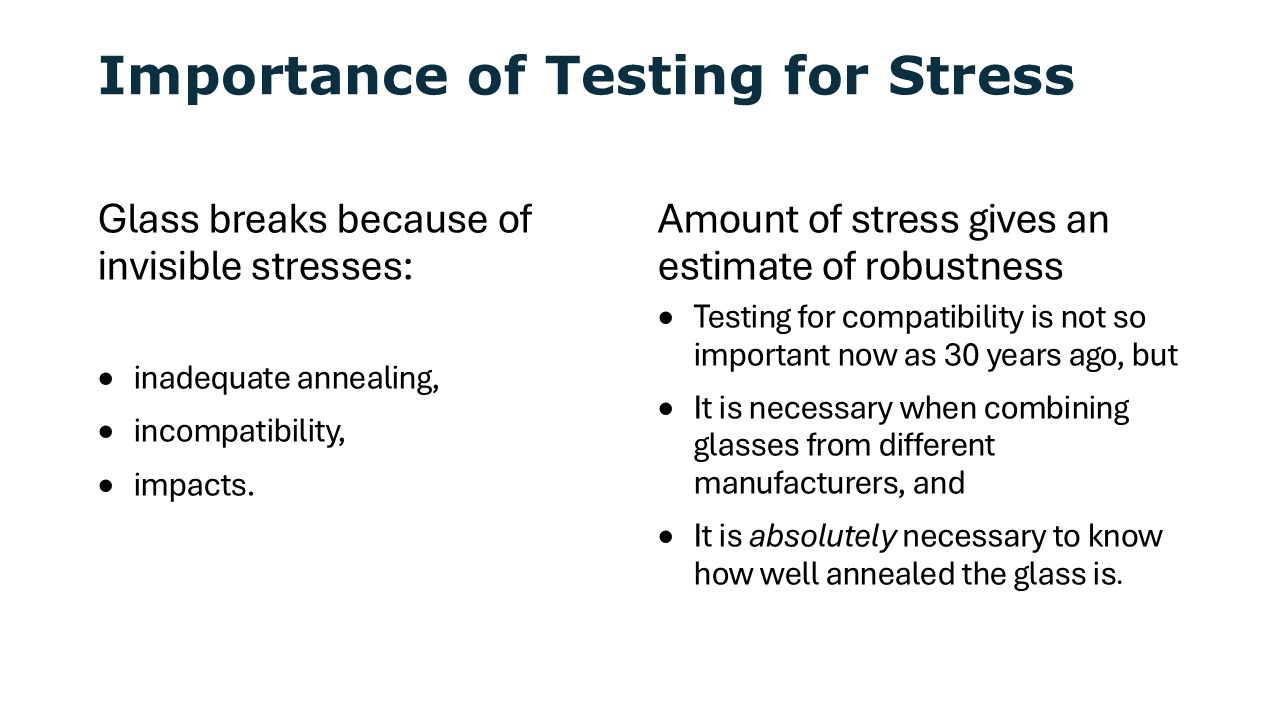
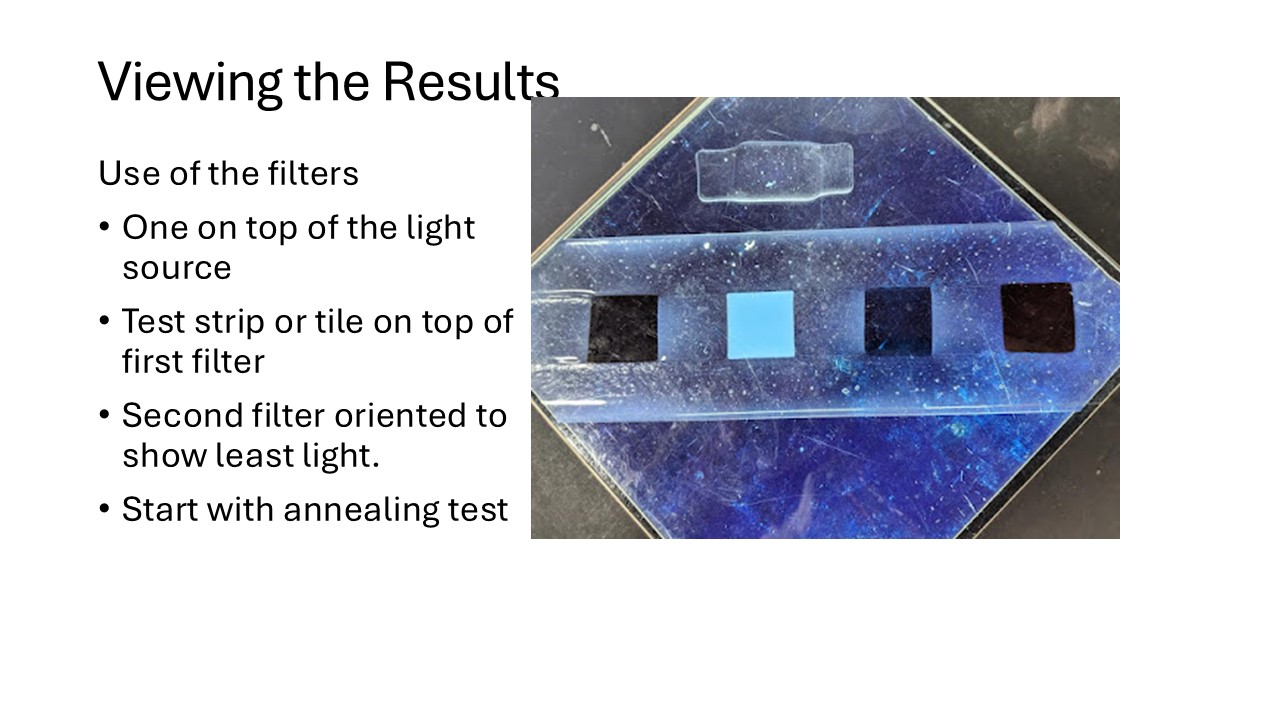
Testing for stress is one of the most important elements in kilnforming.  It may not look like there is stress when there is considerable amounts.  The non-destructive tests are outlined in this Power Point presentation, prepared some time ago, to describe why and how stress testing can be conducted.  There is no commentary.


Wednesday, 9 April 2025

Bone Grafts with Glass

 The use of glass in bone grafts.

image credit: Mo-Sci, Llc


Wednesday, 26 March 2025

Bioactive glass

 A description of bioactive glass from Mo-Sci,Llc

Image credit: Mo=Sci, Llc


Wednesday, 19 March 2025

Bubbles on Single Layer Fusing

“I'm making 3mm French Vanilla sconce covers; …

·        [initially they were] fine, but now 1.5" bubbles form during the full fuse.

·        I pop the bubbles and fill the holes with frit and refire,

·        [The]… edges draw in and distort the design…

·        The shelf is flat,

·        I fire on Bullseye paper, and

·        the 13.5 hour long firing schedule [in F] is:

200 to 1150, hold 30 minutes.

50 to 1225, hold 30 minutes.

300 to 1490, hold 30 minutes.

9999 to 990, hold 60 minutes.

100 to 750, hold 1 minute.

Does anyone know what I can do to avoid the large bubbles? 


A critique of the schedule. 

 This is for a single sheet of 3mm glass, so the hold at 621˚C/1150˚F is unnecessary as is the slow rise to and hold at 663˚C/1225˚F, because it is a single sheet and does not need the traditional bubble squeeze. 


 The hold of 30 minutes at 810˚C/1490˚F is excessive. 

·        The temperature may be too high.

·        Ten minutes at top temperature is sufficient in most cases. 

·        A soak of 1 minute would be enough. 

·        The anneal soak at 990˚F is most probably a misprint for                          516˚C/960˚F. 

·        The anneal soak is longer than the half hour necessary, but not a             bubble creating problem.

 It means the schedule could have been:

111˚C/200˚F to 796˚C/1465˚F for 5 minutes

AFAP to 516˚C/960˚F for 30 minutes

83˚C/150F˚ to 370F˚/700F˚, 0 minutes

Off


Different firing strategies are possible.

  •         Reduce the time at top temperature to no more than 10 minutes. 
  •         Reduce top temperature by 55˚C/100˚F or more and extend the soak to 20 minutes, if necessary.  Peek frequently to see when the kiln work is complete.
  •         Fire on fibre paper covered with Thinfire to allow air out from under the glass.

These strategies can be mixed as desired, and the reasoning for the strategies is:

  • Excessive time at the top temperature allows the glass to thin as it migrates to form thicker areas/edges. This makes the glass too thin to resist the air pressure from below.
  • Reducing the top temperature will increase the viscosity, so              resisting the migration of the glass, and maintain the original            thickness. 
  • Also, single layers are prone to dog boning, but there are ways of reducing it.

Ways to reduce the risk of bubbles appearing in general are:
  •    Reduce the time at the top temperature,
  •    Reduce the top temperature,
  •    Provide ways for the expanding air to migrate from under the glass.