Wednesday, 27 November 2024

Reducing Annealing Time for Float Glass

Credit: Bullseye Glass Co.


Annealing float glass seems take a long time. The annealing point (Tg) is higher than most fusing glasses, although float glass is part of the family of soda lime glass. This group of glasses should be cooled slowly from annealing temperature to 427ºC/800ºF and below to reduce risks of thermal shock.  This makes a greater temperature range over which to  anneal float than fusing glasses, consequently it extends the cooling time and increases energy expenses.

It does not have to be this way.  Annealing of glass takes place over a range.  This range extends below the published annealing point (Tg).  This is the temperature at which equalisation can most quickly take place, but it is not as energy efficient as starting in the lower range.  Annealing points (Tg) vary between manufacturers, but these are some of them:

Pilkington Optiwhite              559ºC/1039ºF

Pilkington Optifloat               548ºC/1019ºF

USA float (typical)                548ºC/1019ºF

Australian float (average)      550ºC/1022ºF

The annealing range extends to a practical 38ºC/68ºF below the Tg temperature.  Annealing at a lower temperature can be as effective at the lower portion of the range as at the Tg.  Using a lower annealing soak temperature reduces the temperature range of the first cooling stage by as much as 38ºC/68ºF, and reduces the cooling time without increasing risks of breaking.  It also creates a denser glass according to scientific research.  Denser glass is arguably a stronger glass.

This means that the annealing of float glass can take place at the following reduced temperatures:

Pilkington Optiwhite              521ºC/971ºF

Pilkington Optifloat               510ºC/900ºF

USA float (typical)                510ºC/900ºF

Australian float (average)      512ºC/954ºF


This reduces the first cooling stage for 12mm/0.5” Pilkington Optiwhite from 2 hours 24 minutes to 1 hour 43 minutes.  Forty-one minutes may not seem much but in electricity costs is significant.  Also using the Bullseye concept of a three stage cooling, further savings can be made.  Their research shows the second cooling stage to 371ºC/700ºF can be increased by 1.8 times the first cooling rate, saving further time and energy.  The chart which shows these rates is Annealing Thick Slabs -  Celsius and - Fahrenheit.


More information on annealing is available in the ebook Annealing: Concepts, Principles and Practice


Annealing float glass at the lower part of the annealing range reduces the time and cost of firings.

Wednesday, 20 November 2024

Grinder Bit Chipping Glass

Credit: Techniglass.com


A new grinder bit chips the glass excessively, especially with a coarse grit. It can also be the result of a bare spot on the bit.  You need distinguish between these states.   Check the surface of the bit.  If there are any small bare spots, the bit needs to be replaced.


Credit: WWGrainger

The best thing to do with a new coarse bit is to treat it with a dressing stone.  This is a block of aluminium oxide which can remove high points on the bit, and clean up the spaces between the diamonds on the bit.  It is relatively inexpensive to buy and lasts a long time.  The dressing stone can be a brick, although it is not as efficient because it is much softer.  

If the grinding bit still chips off too much glass from the edge, you need  a finer grit.  It will not take glass off as quickly as the coarse one, but it eliminates or reduces the chipping.  The three common grades are: coarse, standard, and fine.  It is a good idea to maintain a stock of the medium and fine grit grinder bits as replacements for worn ones.

Tuesday, 19 November 2024

Hole Placement

 How close to the edge of the glass can I drill a hole for hanging?

The rule in glazing large toughened glass walls is that the edge of the hole must be at least 1mm further away from the edge of the glass than the thickness of the glass. The reasoning behind this is the same as the one that says you can’t cut a strip equal or thinner than the thickness of the glass. A strip won’t break off cleanly because the strip is weaker, and it breaks off in pieces.

In the same way a hole closer to the edge of the glass than the thickness will be create a weakness and be subject to breaking. But if the edge of the hole is further away, the glass space has the same strength as the general thickness of the glass.


For example, a 3mm (0.0625”) hole in 6mm (0.25”) glass needs to have the hole edge at least 7mm (0.28”) from the edge of the glass. The centre of the 3mm hole is 1.5mm from its edge, so the centreline of the hole must be at least 8.5mm (0.33”) from the edge of the glass. If it is a 1mm (0.04”) hole in 3mm (0.0625”) glass the centre line needs to be 4mm plus 0.5, or 4.5mm (0.18”) minimum from the edge.


Of course, for heavy or structural glass you probably should double those calculations, just like civil engineers do.


For other tips on glass drilling see:

Keeping things wet
Using a drill press
Drilling with a Flushing Head
Avoiding chipping
Drilling holes with copper tube and grit
Drilling tools
Drilling glass without a drill press
Hole Placement
Drilling Speeds for diamond bits

Wednesday, 13 November 2024

Core drill bits

Credit: JMbestglass.cn


Using core drill bits needs a drill press. It keeps the drill bit steady and avoids breaking the core which plugs the hollow part of the bit.

Oscillating a core diamond drill bit is not the correct procedure. Oscillating the bit creates two undesirable things.

  • It breaks off the core that  is being drilled out, plugging the drill bit, and blocking the cooling water being pumped to the drill bit.  This means the bit heats up and loses some of the diamonds. Additionally, it can heat up the glass so much that it breaks. If you are not using a flushing head with your drill, you will need to raise the bit a little from time to time, allowing water to the grinding surface. 
  • Starting at an angle or oscillating with a core bit wears out the sides of the drill bit more quickly than necessary. Core drill bits need to be applied directly and vertically. This is why core bits do best in a drill press. It holds the bit in a vertical position without breaking the core being drilled out, or prematurely using the diamonds higher up the bit.

Credit:  Lawson-HIS


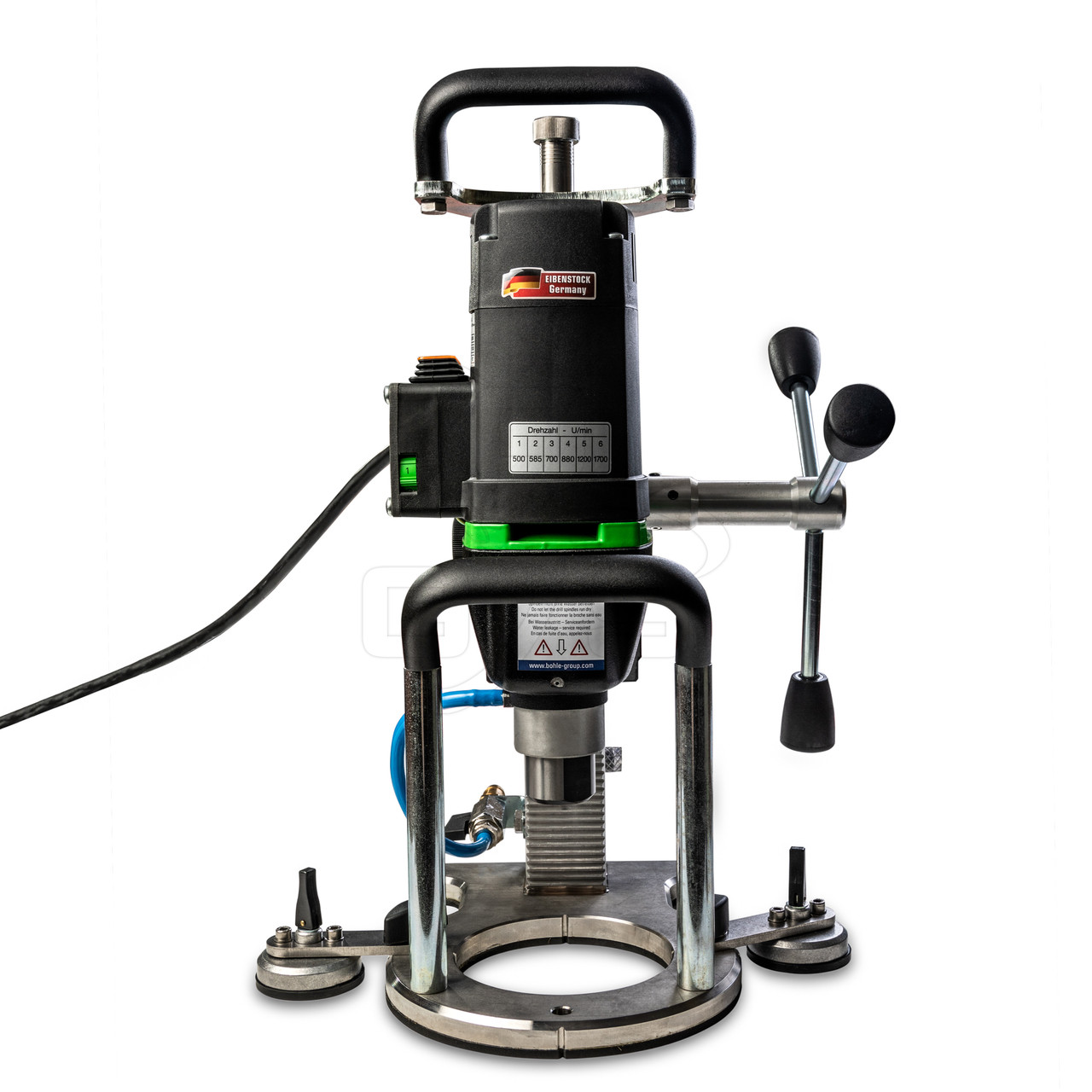
There are generic drill presses available for holding Dremel-type craft motors and hand-held drills. They are inexpensive and make the drilling process so much more certain to regulate the pressure. It also makes an easier start without skipping over the glass. They are so inexpensive that a few holes without skipping will pay it.

Credit: Bhole ST1542 Pico Dril


Drill speeds should be varied according to the size of the hole being drilled. This is important with the high speed Dremel-type motors.  Larger holes need a slower speed than smaller ones. The rim speed of a small bit is nearer the rpm of the drill than a larger one, because the larger one travels a greater distance per revolution than a small one. A listing of recommended speeds is given in this blog.

Hollow core diamond bits are of two types:

  •     One, where a heating process attaches the diamond, is called sintered in Europe and other countries.
  •     The second, where the diamond is bound with resins, is called bonded in Europe.

They seem to have different designations in North America.

Bits of the first type are longer lasting, and more expensive. These can be “sharpened” with an aluminium oxide dressing stick to expose new diamonds and maintain their effectiveness.

Credit: W W Grainger.com


Bits of the second type wear quickly and should not be “sharpened” with a dressing stone. The normal wearing away of the bonding material exposes the new diamonds.  Dressing them wears away the diamonds that could be used in drilling.

Another advantage to core bits, is that a core drill grinds out much less glass from the hole than a solid drill bit, so it takes less time to drill a hole.

One disadvantage, especially on core drills of 5mm and less, is that the core needs frequent cleaning out of the cores that get stuck inside the drill bit. To maintain efficient and effective drilling, the core needs to be poked out from the bit from the base toward the drilling surface.  This applies whether water is being pumped through the core or not.  Without clearing the core, more pressure must be used to continue drilling, resulting in larger break outs as the hole is completed, and more breaks of the complete piece.

Wednesday, 6 November 2024

Rigidisers - Application and Use

credit: Scarva


Material

Rigidisers are colloidal solutions of silica or quartz with a carrier of some form.  It is also available as a powder to mix with water according to the instructions.

Health and Safety 

Silica and quartz (sometimes referred to as flint) in dry powdered form are a serious health risk.  Wear good respiratory protection and long sleeves and gloves against its skin irritant.  Work outside with the powdered form to keep the dust out of the studio. Clean clothing immediately after working with the powdered form of rigidiser.  Wearing gloves is a good idea whenever working with rigidisers, as the wet form is also a strong skin irritant.

Application

Mix up the powdered form as 1 part powder to 4 parts water, by volume.  Do this masked and gloved, and outdoors if possible.  If not, have a HEPA vacuum running next to your work area.  Mix thoroughly and allow to slake for 24 hours.  Then mix very well by hand or with a blender.  Strain the mix to remove any clumps - they can be made into a paste and added to the main solution.

Liberally paint the solution onto the refractory fibre.  Stir prior to use and frequently throughout the application to keep the silica/quartz in suspension.  Depending on permanence, coat one or both sides of the paper/blanket/board.  It is not necessary to soak the fibre completely.  The object is to provide a hard surface.  It does not need to be hard throughout.

Flat Board

It is best to apply rigidiser on both sides of refractory board.  If rigidising both sides, allow one side to air dry before turning over to coat the other side.  By coating both sides, the warping from heating on one side is reduced. 

Slumping forms 

Cover the shape you are taking the mould from with an impervious separator such as Vaseline or thin plastic film.  Prepare the fibre blanket by coating both sides of the fibre with the rigidiser.  It does not need to be completely soaked.  Press the fibre firmly into/onto the shape and especially into any depressions and around any protrusions to be certain of a faithful replication.

Curing  

Allow the refractory fibre to air dry.  Or if needed quickly, you can kiln dry at 90˚C – 110˚C / 194˚F – 258˚F for several hours.  But only if the master mould can withstand the heat.  If not, demould only after the fibre is dry and can hold its shape without the master.  Be sure to remove the master mould from the fibre before proceeding to heat cure.

When air dried, cure in the kiln by firing to 790˚C/1454˚F for 20 minutes.  Before firing, place the dry form on a refractory fibre separator to avoid the silica/quartz sticking to the shelf. A rapid rate straight to the top temperature is acceptable.  After the soak, turn the kiln off, as the rigidised refractory material is not subject to thermal shock.

In Use

Coat the hardened fibre in kiln wash, or cover with shelf paper or refractory fibre paper, to avoid glass sticking to the hardened board.  The bare surface of the rigidised form is now coated in glass fibres and they will stick to the glass unless a separator is applied.

When used as a shelf, it is best to turn the board over after a few dozen firings. This helps counteract the warping tendency that rigidised boards have.