If copper foiled pieces sit out for any length of time after foiling they will oxidize. This means that the solder will not stick to the foil, as it requires a clean surface to attach to.
Clean the foiled pieces with fine steel wool, pot scrubber or flexible mild abrasive. Make sure you do not damage the foil or pull it up from the glass during this process. It is likely that the adhesive holding the foil to the glass is not as strong as it once was.
I do not recommend using a stronger flux to overcome the oxidisation, as this is often highly acidic and may damage the glass.
Once cleaned, you can flux the foil and proceed as normal.
Tuesday, 11 August 2009

Friday, 31 July 2009
Weaving in Leaded Glass
"Weaving" is only easily and fully done where there is a grid. The example below shows a restoration project where the main part of the panel is a grid.
This image shows the starting of the weaving. A short lead covering only one quarry has been placed horizontally - although you can start with a short vertical, both are fine. The next lead is vertical and covers two of the quarries. As you can see here the two quarries at the right are ready for the longer horizontal to be placed.

You proceed in this fashion - alternating long and short leads throughout the grid area.


This image shows the starting of the weaving. A short lead covering only one quarry has been placed horizontally - although you can start with a short vertical, both are fine. The next lead is vertical and covers two of the quarries. As you can see here the two quarries at the right are ready for the longer horizontal to be placed.

You proceed in this fashion - alternating long and short leads throughout the grid area.
As you can see this builds up in a diagonal fashion with each vertical and horizontal line being interrupted after every second piece of glass.
If you look closely you can also see that these leads are being tucked. This is easier with leads of 7mm and greater than of 6mm and less.
This method of leading gets its name from the similarity to representations of weaving in illustrations where a broken line represents the thread or reed going under another. Its purpose is to avoid hinges and so strengthen the whole panel. This avoidance of hinges makes the turning of the panel during soldering and cementing much easier.
Of course, you must remember that the glass is the strongest part of the panel.
Monday, 27 July 2009
Direct or Trace cutting
Place the glass over the pattern and run the cutter along the pattern lines you see by looking through the glass. There's no need to draw lines on the glass. For translucent glass you may need a light box.
You should be aiming to cut glass efficiently and accurately. Trace cutting is the most efficient, as it completes in a single operation what other methods –such as drawing on the glass or making templates from the cartoon - take several steps to accomplish.
It is more accurate because each extra step required for other methods increases the possibility for error. The fewer times you copy the original pattern lines, the less likely you are to diverge from the original pattern lines.
It is very important to keep the cutter at right angles to the glass - as seen from side to side, not vertical. This of course is true of all cutting. It makes the cutting inaccurate, because the light is bent when coming through the glass much like water changes the apparent angle of sight into its depths. Tilted cutters also have undesirable effects when breaking the glass.
You should be aiming to cut glass efficiently and accurately. Trace cutting is the most efficient, as it completes in a single operation what other methods –such as drawing on the glass or making templates from the cartoon - take several steps to accomplish.
It is more accurate because each extra step required for other methods increases the possibility for error. The fewer times you copy the original pattern lines, the less likely you are to diverge from the original pattern lines.
It is very important to keep the cutter at right angles to the glass - as seen from side to side, not vertical. This of course is true of all cutting. It makes the cutting inaccurate, because the light is bent when coming through the glass much like water changes the apparent angle of sight into its depths. Tilted cutters also have undesirable effects when breaking the glass.
Friday, 24 July 2009
Tinning brass vase caps
Tinning brass vase caps can help in obtaining a secure joint without long dwells at each joint that risk overheating the glass.
Heat your vase cap with a torch of one kind or another. You can heat until it becomes a dull red. The quickly brush or rub (with a cloth) flux onto the inside and outside of the rim of the vase cap. Apply a little solder to the fluxed area while everything is still hot. This will tin all the areas where the flux was placed.
This method will give a strong solder to solder joint that requires much less time when soldering the cap to the rest of the lamp shade.
Heat your vase cap with a torch of one kind or another. You can heat until it becomes a dull red. The quickly brush or rub (with a cloth) flux onto the inside and outside of the rim of the vase cap. Apply a little solder to the fluxed area while everything is still hot. This will tin all the areas where the flux was placed.
This method will give a strong solder to solder joint that requires much less time when soldering the cap to the rest of the lamp shade.
Wednesday, 22 July 2009
Leaded Glass Reinforcements
I received a query recently about this subject. As the correspondence may be useful to a more general audience, I present an edited version here. (all the personal chat has been taken out!)
“I was wondering if I would be able to ask you a question regarding re-enforcements. In regards to the hollow lead with the bar running through or using Reforce with the brass molded through it. Which is better?”
The lead covered steel is stronger. It has the disadvantage that if it gets moisture into it, it will corrode. Steel expands when it corrodes. This leads to progressive destruction of the surrounding glass.
Brass is weaker, but does not have the same degree of expansion when corroding.
Steel is cheaper than brass.
These factors have to be taken into account when deciding on which to use. So I don’t have a definitive response for your situation.
Really any time you need to reinforce a panel, it is because it is too large to reliably support itself. Often this is because it is too tall or too wide. Big windows have always been built in sections, with each stacked upon top of the lower ones. There are saddle bars or ferramenta added to the window opening to strengthen the window.
It is important to note that in compression glass is much stronger than steel. It is when the glass is in tension that it is weaker. So what the reinforcement is doing is resisting any lateral movement. It is not holding the glass up. The glass can do that very well on its own. The glass is subject to lateral movement from wind pressures mostly. But in some situations as in doors, it is subject to inertial movements - the door closes and sometimes slams. In other installations there is vibration – such as sidelights. The re-enforcement is to counteract or reduce this movement.
In general, if the panel needs reinforcement, it is too large as a single panel, and needs to be built in several panels. Some people hate to have the line of the panel joints, but the eye generally ignores those straight lines (unless they are out of true horizontal or vertical).
Some questions you need to ask yourself about reinforcement are:
Do you really need to reinforce?
Must it be within the panel?
Can you use external support?
Why would two hinges be better than one?
Remember the reason for not having a hinge is because the glass is the strongest element in a leaded or copper foiled window. Therefore a window with complicated lines will be a stronger window as the glass interlocks. If you look at many older windows you will see a number of hinges, and the windows are still there. I attach an image of a stair window that has been in place for just under 100 years. It has a multiplicity of hinges. I am not saying don't concern yourself about hinges, but keep a sense of proportion.

Nowadays, I keep all my reinforcements to the surface of the panels, not inside. Also if you want to join panels in a large window, it is not essential that the join be horizontal or vertical. It could be in a wave, sinuous curve or in a stepped fashion. Your imagination is probably the limit here, not the material.
The enquirer then sent pictures with further information.
“These are the latest 3 panels I’ve made for my bungalow out the back. They measure 1100mm high by 500 wide approx. I’ve made them all with different reinforcement applications. I was told they would not need any but still wanted to strength them up.
“The middle you can see I broke the hinge line with two pieces of re-force and on the other two I’ve gone all the way through to the outer border. All other lead lines do not go more than 2 pieces of glass before they are crossed by another piece of lead to break up that hinge thing.
“Due to the size/design I’d appreciate your thoughts on what I’ve done being correct/overkill?”
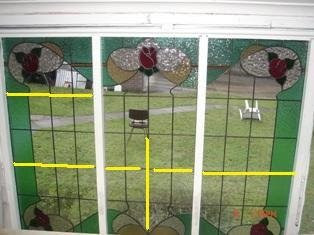
The two outer panels are supported appropriately. I believe the right one is adequately reinforced, and the left is over reinforced, but there will be no harm. The middle one is not adequately reinforced. The broken horizontal reinforcement transfers the stresses to the middle. The vertical one also transfers the stresses to the middle, only a little higher.
For reinforcement to work, it needs to transfer the stresses to the sides/tops of the panel where they will be captured by the framing. Thus the reinforcement needs to be a continuous line. The strongest reinforcement will be across the shortest dimension of the opening.
The weaving of the lead lines described by you as “lead lines do not go more than 2 pieces of glass before they are crossed by another piece of lead to break up that hinge thing” is exactly the right thing to do in these panels.
In the case you are illustrating, there should be no problems for several generations at minimum and possibly for a century.
"I’ve also included one other piece I’ve designed and cut which is going to be installed in an internal wall inside a home. Its 800/800mm approx and due to it being kept out of the weather was wondering about what type of re-enforcement structure would suit?"

As this will be an internal panel, I suggest that the best reinforcement would be a toughened/tempered sheet of 4mm float glass installed behind the panel. This will provide support in case someone leans against it. Yes, there is a diagonal hinge at the trunk, but the strongest reinforcing for this would simply be a horizontal bar behind the panel, which would look ugly and I don't think you want anyway.
“I was wondering if I would be able to ask you a question regarding re-enforcements. In regards to the hollow lead with the bar running through or using Reforce with the brass molded through it. Which is better?”
The lead covered steel is stronger. It has the disadvantage that if it gets moisture into it, it will corrode. Steel expands when it corrodes. This leads to progressive destruction of the surrounding glass.
Brass is weaker, but does not have the same degree of expansion when corroding.
Steel is cheaper than brass.
These factors have to be taken into account when deciding on which to use. So I don’t have a definitive response for your situation.
Really any time you need to reinforce a panel, it is because it is too large to reliably support itself. Often this is because it is too tall or too wide. Big windows have always been built in sections, with each stacked upon top of the lower ones. There are saddle bars or ferramenta added to the window opening to strengthen the window.
It is important to note that in compression glass is much stronger than steel. It is when the glass is in tension that it is weaker. So what the reinforcement is doing is resisting any lateral movement. It is not holding the glass up. The glass can do that very well on its own. The glass is subject to lateral movement from wind pressures mostly. But in some situations as in doors, it is subject to inertial movements - the door closes and sometimes slams. In other installations there is vibration – such as sidelights. The re-enforcement is to counteract or reduce this movement.
In general, if the panel needs reinforcement, it is too large as a single panel, and needs to be built in several panels. Some people hate to have the line of the panel joints, but the eye generally ignores those straight lines (unless they are out of true horizontal or vertical).
Some questions you need to ask yourself about reinforcement are:
Do you really need to reinforce?
Must it be within the panel?
Can you use external support?
Why would two hinges be better than one?
Remember the reason for not having a hinge is because the glass is the strongest element in a leaded or copper foiled window. Therefore a window with complicated lines will be a stronger window as the glass interlocks. If you look at many older windows you will see a number of hinges, and the windows are still there. I attach an image of a stair window that has been in place for just under 100 years. It has a multiplicity of hinges. I am not saying don't concern yourself about hinges, but keep a sense of proportion.
Nowadays, I keep all my reinforcements to the surface of the panels, not inside. Also if you want to join panels in a large window, it is not essential that the join be horizontal or vertical. It could be in a wave, sinuous curve or in a stepped fashion. Your imagination is probably the limit here, not the material.
The enquirer then sent pictures with further information.
“These are the latest 3 panels I’ve made for my bungalow out the back. They measure 1100mm high by 500 wide approx. I’ve made them all with different reinforcement applications. I was told they would not need any but still wanted to strength them up.
“The middle you can see I broke the hinge line with two pieces of re-force and on the other two I’ve gone all the way through to the outer border. All other lead lines do not go more than 2 pieces of glass before they are crossed by another piece of lead to break up that hinge thing.
“Due to the size/design I’d appreciate your thoughts on what I’ve done being correct/overkill?”
The two outer panels are supported appropriately. I believe the right one is adequately reinforced, and the left is over reinforced, but there will be no harm. The middle one is not adequately reinforced. The broken horizontal reinforcement transfers the stresses to the middle. The vertical one also transfers the stresses to the middle, only a little higher.
For reinforcement to work, it needs to transfer the stresses to the sides/tops of the panel where they will be captured by the framing. Thus the reinforcement needs to be a continuous line. The strongest reinforcement will be across the shortest dimension of the opening.
The weaving of the lead lines described by you as “lead lines do not go more than 2 pieces of glass before they are crossed by another piece of lead to break up that hinge thing” is exactly the right thing to do in these panels.
In the case you are illustrating, there should be no problems for several generations at minimum and possibly for a century.
"I’ve also included one other piece I’ve designed and cut which is going to be installed in an internal wall inside a home. Its 800/800mm approx and due to it being kept out of the weather was wondering about what type of re-enforcement structure would suit?"

As this will be an internal panel, I suggest that the best reinforcement would be a toughened/tempered sheet of 4mm float glass installed behind the panel. This will provide support in case someone leans against it. Yes, there is a diagonal hinge at the trunk, but the strongest reinforcing for this would simply be a horizontal bar behind the panel, which would look ugly and I don't think you want anyway.
Friday, 17 July 2009
Positioning the Circle Cutter.
If you have a suction cup on the circle cutter, it will be easier to hold in place. But a three legged circle cutter is possible to keep in place too.
In both cases, one hand holds down the centre and the other operates the cutter. Make a test circle with no pressure to ensure before you start that the cutting bar will not bump into anything else on the bench. This also ensures that you have the circle to be cut placed appropriately on the glass.
To make the score start with the bar under your supporting arm and swing around to the other side of your arm until you hear the click or scratch indicating that you have come back to the start.
In both cases, one hand holds down the centre and the other operates the cutter. Make a test circle with no pressure to ensure before you start that the cutting bar will not bump into anything else on the bench. This also ensures that you have the circle to be cut placed appropriately on the glass.
To make the score start with the bar under your supporting arm and swing around to the other side of your arm until you hear the click or scratch indicating that you have come back to the start.
Monday, 13 July 2009
Lead and Copper Foil in the Same Panel
It is possible to combine copper foil in a leaded glass panel.
The copper foiled piece should be soldered before inserting it into the lead came. In this way the soldered together pieces become very like another piece of glass.
There are some special considerations, of course.
The copper foiled piece should be designed as though it were a single piece of glass and so can be accommodated into the surrounding pieces of glass. Copper foiled piece should not have severe undercuts which would make it difficult to insert into the surrounding glass. It may be necessary to incorporate a piece of the surrounding colour to make it fit into the panel.
The copper foiled piece should be finished with all the beads on both sides. If one side is left flat, it will collect water if on the outside, and catch on any cleaning processes whichever side it is on. However, the piece should be tinned only on the outer edges. This will ensure that the copper foiled piece will slip into the came.
The image below illustrates a copper foiled piece incorporated into a leaded panel.

This section of the panel shows the accommodation of the main leaded panel with the copper foiled piece with a line from a petal to a leaf. Otherwise, it was fitted as one piece.
Wednesday, 8 July 2009
Templates of openings, 6
When the opening is in stone, slight variations occur in the process of taking a template. The main difference is that the rebates are concealed. The rebates are slots into the stone. Thus, the template must slip into the slotted rebate. In these cases, the stiffer the material being used to take template, the better. Usually, thin plywood is the best material, as it has to be manipulated many times and in ways similar to the final panel.
Things are further complicated, as tracery is more common in stone than in timber framed openings. A complex opening shape may require two or more parts to enable the panel to be inserted. The taking of a template will help greatly in figuring out how the panel will be inserted into the opening.
Additionally, when the template is in position, you should mark the visible portion of the opening onto the template. Mark which is the inside and which the outside. Finally, mark on each template which side has the deeper slot as this will help in installation.
Things are further complicated, as tracery is more common in stone than in timber framed openings. A complex opening shape may require two or more parts to enable the panel to be inserted. The taking of a template will help greatly in figuring out how the panel will be inserted into the opening.
Additionally, when the template is in position, you should mark the visible portion of the opening onto the template. Mark which is the inside and which the outside. Finally, mark on each template which side has the deeper slot as this will help in installation.
Monday, 6 July 2009
Templates of Openings, 5 – Irregular Openings
Irregular openings such as trefoils and other tracery need to have templates taken with consideration on how the final panel can be put into the opening.
In the cases where the whole of the rebate is exposed, it is normally possible to put the panel in as a single whole piece.
So, the template is taken as for any other opening. It is more complex and time consuming as there are so many more sides than in a simple rectangular or circular opening.
In the cases where the whole of the rebate is exposed, it is normally possible to put the panel in as a single whole piece.
So, the template is taken as for any other opening. It is more complex and time consuming as there are so many more sides than in a simple rectangular or circular opening.
Saturday, 4 July 2009
Templates of openings, 4
Round headed openings can be considered as a special case of a circle.
The horizontal you must find is the shoulder of the window. This is the place from which the curve springs on each side. The opening is generally vertical up to this point and then begins the curve.
You need to make sure you have marked where this shoulder is on the template. You should indicate any reference points from the frame onto the template.
The join to the lower part of the window must be made obvious. Normally there will be an overlap between the lower rectangular template and this approximate half circle. You need to mark where this overlap occurs, if you do not fasten the two sheets together. This can be done by marking across the two sheets in a few places. This will enable you to join them exactly back at the studio.
The horizontal you must find is the shoulder of the window. This is the place from which the curve springs on each side. The opening is generally vertical up to this point and then begins the curve.
You need to make sure you have marked where this shoulder is on the template. You should indicate any reference points from the frame onto the template.
The join to the lower part of the window must be made obvious. Normally there will be an overlap between the lower rectangular template and this approximate half circle. You need to mark where this overlap occurs, if you do not fasten the two sheets together. This can be done by marking across the two sheets in a few places. This will enable you to join them exactly back at the studio.
Thursday, 2 July 2009
Templates of openings, 3 - Circles
Occasionally the window is circular and sometimes an oval. In both cases a template is important. The circle rarely is exact. Take the template in the normal way and then ensure you mark the verticals and horizontals for the opening. You often can use the jointing in the woodwork to help with these. Also mark any other reference points from the opening. Finally, mark which is the outside and which the inside.
This procedure will ensure that you will be able to fit the panel into the opening.
This procedure will ensure that you will be able to fit the panel into the opening.
Tuesday, 30 June 2009
Templates of Openings, 2
Irregular rectangles
If you have found or can see that the opening is not a true rectangle and cannot determine where any right angles are, you need to take a template.
The objective is to make a piece that will fit into the opening without bending or being too small for the space. It will be the same size as the finished panel and so you will be able to put the finished panel into the opening without needing to trim or expand the panel.
First, trim the sheet of material you have chosen to use to a size a little larger than the measured size. Place the uncut side along one of the long sides of the opening. If the opening is a portrait format, place it on the right or left side as convenient to you.
Next, adjust the bottom by marking a line on the sheet. This is where a second person is very useful. One person can hold the sheet in place on outside of the opening and the other do the marking from the inside –in the case of the rebate being on the outside and vice versa if the rebate is on the inside. The marked line should be as close to the edge of the rebate as possible. The special case of an opening in stone will be dealt with separately.
Then take the sheet to a place where it can be safely cut. A long metal straight edge and craft or “Stanley” knife are often the best aids to cutting straight lines. Replace the sheet into the opening after cutting, and make any adjustments to the size and angles of the sheet at the bottom by marking and cutting as necessary.
When the side and bottom are adjusted, start on the other side. Proceed as for the bottom.
When the side is finished, start on the top.
Finally, present the whole sheet to the opening to make sure it slips into place with no snags, or bending of the sheet.
It may be that the opening is too large for a single sheet. In that case you will need to work with two or more sheets and try them together for the final fitting into the opening. You can put them together in the window. You can fasten them together with tape or other fasteners to make one sheet. You can also make two parallel lines both at angles and at intervals across the sheet so that when you get back to the studio you can exactly reproduce the full sheet by matching the marks and then firmly fastening them together. This makes transport of large templates much easier.
You will know that a panel made to a template made in this way will fit into the opening, no matter how irregular the opening may be.
If you have found or can see that the opening is not a true rectangle and cannot determine where any right angles are, you need to take a template.
The objective is to make a piece that will fit into the opening without bending or being too small for the space. It will be the same size as the finished panel and so you will be able to put the finished panel into the opening without needing to trim or expand the panel.
First, trim the sheet of material you have chosen to use to a size a little larger than the measured size. Place the uncut side along one of the long sides of the opening. If the opening is a portrait format, place it on the right or left side as convenient to you.
Next, adjust the bottom by marking a line on the sheet. This is where a second person is very useful. One person can hold the sheet in place on outside of the opening and the other do the marking from the inside –in the case of the rebate being on the outside and vice versa if the rebate is on the inside. The marked line should be as close to the edge of the rebate as possible. The special case of an opening in stone will be dealt with separately.
Then take the sheet to a place where it can be safely cut. A long metal straight edge and craft or “Stanley” knife are often the best aids to cutting straight lines. Replace the sheet into the opening after cutting, and make any adjustments to the size and angles of the sheet at the bottom by marking and cutting as necessary.
When the side and bottom are adjusted, start on the other side. Proceed as for the bottom.
When the side is finished, start on the top.
Finally, present the whole sheet to the opening to make sure it slips into place with no snags, or bending of the sheet.
It may be that the opening is too large for a single sheet. In that case you will need to work with two or more sheets and try them together for the final fitting into the opening. You can put them together in the window. You can fasten them together with tape or other fasteners to make one sheet. You can also make two parallel lines both at angles and at intervals across the sheet so that when you get back to the studio you can exactly reproduce the full sheet by matching the marks and then firmly fastening them together. This makes transport of large templates much easier.
You will know that a panel made to a template made in this way will fit into the opening, no matter how irregular the opening may be.
Friday, 26 June 2009
Templates of Openings, 1
If you have an irregular opening, it may be best to take a tracing of the opening. Usually this will be in a larger opening and so a helper may be necessary to hold things.
The material used to take the template must have a few characteristics:
- It must be stiff enough to have the minimum possible bend over the width or height of the opening
- It must be easy to mark with a pencil or other implement
- It must be easy to cut or shape
- It should be light to make it easy to lift it to the opening for the many adjustments that will be required.
A number of materials can be used: stiff card, mounting board, corrugated cardboard, thin plywood, and many other sheet materials. I have found stiff corrugated cardboard easy to use.
More information in this series is at:
Irregular rectangles
Circles
Round headed windows
Irregular shapes
Stone
The material used to take the template must have a few characteristics:
- It must be stiff enough to have the minimum possible bend over the width or height of the opening
- It must be easy to mark with a pencil or other implement
- It must be easy to cut or shape
- It should be light to make it easy to lift it to the opening for the many adjustments that will be required.
A number of materials can be used: stiff card, mounting board, corrugated cardboard, thin plywood, and many other sheet materials. I have found stiff corrugated cardboard easy to use.
More information in this series is at:
Irregular rectangles
Circles
Round headed windows
Irregular shapes
Stone
Monday, 22 June 2009
Measuring a Rectangular Opening.
1 - Measure at both the top and bottom for width.
2 - Measure at the left and right sides for height.
If it is a tall or wide opening measure at intervals and at least in the middle of each side.
So far so good. But how do you know that it is a rectangle rather than a parallelogram? Measure the diagonals – bottom left to top right and top left to bottom right. If these measurements are equal or +/- 5mm you can consider the opening to be a rectangle.
With bigger variations you may set out the cartoon using the measurements for the opening. Still, you need to know where the right angles are, if there are any, to be able to set out the cartoon to properly fit the opening.
So you may wish to take a template of the opening.
2 - Measure at the left and right sides for height.
If it is a tall or wide opening measure at intervals and at least in the middle of each side.
So far so good. But how do you know that it is a rectangle rather than a parallelogram? Measure the diagonals – bottom left to top right and top left to bottom right. If these measurements are equal or +/- 5mm you can consider the opening to be a rectangle.
With bigger variations you may set out the cartoon using the measurements for the opening. Still, you need to know where the right angles are, if there are any, to be able to set out the cartoon to properly fit the opening.
So you may wish to take a template of the opening.
Saturday, 13 June 2009
Bulging lead panels
There is probably no means by which leaded glass, because of the innate character of lead as its skeleton, can resist its propensity to bend, bulge and sag. Evidence of these occurrences does not necessarily foretell disaster or immediate collapse. Bulging does not necessarily indicate the need for action or re-leading.
There are three basic stages through which stained glass passes on the way to requiring repair;
1. Bulging, bending and sagging
2. Loss of putty and breaking of solder joints
3. Unhousing of the glass from the lead
The points at which solder joints break depends on the materials used.
Since lead, compared with solder, is a resilient material abutting the more resistant solder, breaks will occur most frequently at the junction of the solder with the lead.
With zinc, the situation is reversed. The zinc is of greater resistance than the solder. As a result the break most often occurs on the solder at the point of the zinc junctions.
It is the very existence of resilience in lead which responds to the expansion and contraction of glass that permits the more healthy survival of the glass over the less sympathetic accommodations of either zinc or copper foil. Leaded glass, unlike any other medium, has the unique capability of having its skeleton (lead) replaced, when the need arises, without damaging its body (glass).
There are three basic stages through which stained glass passes on the way to requiring repair;
1. Bulging, bending and sagging
2. Loss of putty and breaking of solder joints
3. Unhousing of the glass from the lead
The points at which solder joints break depends on the materials used.
Since lead, compared with solder, is a resilient material abutting the more resistant solder, breaks will occur most frequently at the junction of the solder with the lead.
With zinc, the situation is reversed. The zinc is of greater resistance than the solder. As a result the break most often occurs on the solder at the point of the zinc junctions.
It is the very existence of resilience in lead which responds to the expansion and contraction of glass that permits the more healthy survival of the glass over the less sympathetic accommodations of either zinc or copper foil. Leaded glass, unlike any other medium, has the unique capability of having its skeleton (lead) replaced, when the need arises, without damaging its body (glass).
Wednesday, 10 June 2009
Combing Glass
This process is done at relatively high temperatures for fusers – around 925C. It consists of pulling or dragging the surface of the hot glass to produce a marbling effect.
Preparation:
A batt washed ceramic shelf is the best surface. You can use fibre paper on your shelf, but you must be careful to avoid raking deeply enough so that you pick up the fibre and drag it into the glass.
Make a boundary with 10-12mm fibre board on your shelf. You can use strips - for the most efficient use of the board – or cut a shape from a sheet. If you are using strips, fasten them together with wire staples. This will resist the glass flowing at the edges.

Place the glass into the space created by the fibre board. You can place 10mm strips on edge to form very tight lines, you can shingle glass to give broader lines, or you can place the glass in a more random way to give quite different effects.

When shingling or placing glass randomly, it is often best to cut a sheet of iridised clear to lie on the bottom to ensure you have enough depth of glass. Placing the iridised side of glass down toward the shelf provides an additional release, and can give added interest to the back. Anything less than 8-10mm thick leaves the glass pulled away from the edges in the direction of the combing.
Firing:
The initial temperature rise can be fast because the glass is made up of narrow strips. No bubble squeeze is required for the vertical or shingled strips, as there are easy ways for the air to escape. Randomly placed glass should have a bubble squeeze at around 650°-675°C for 30 minutes at least. Otherwise you can fire at about 300°C/hr to 925°C.
You need to programme a soak at that temperature for approximately 120 minutes. This soak allows you to do the combing and have the kiln recover temperature without needing to re-programme. When the combing is finished you cancel the soak after the kiln recovers to 925°C (which allows any peaks generated during the combing to settle down).
Allow or programme the kiln to cool as fast as it can to the annealing temperature and soak for 120 to 180 minutes. Set the annealing cool at 30°C/hour down to 450°C, then 60°C/hour to 370°C and finally at 200°C/hr to 21°C.
Combing:
Safety first. You must do you combing in a kiln that has a safety switch to turn the power off once the lid is opened a short way. If your kiln does not have such a safety device you should reconsider your desire to comb in your kiln. Many say you can overcome this by switching your kiln on and off at the wall socket. However, in doing so you also turn off the controller, making it necessary to re-programme your kiln each of the several times you have to reach into the kiln with your raking tool. This is essentially impractical.
The combing tool is a pointed steel rod, bent at right angles to the shaft - often called a rake. The shaft should be of wood to avoid holding a hot metal rod in your hand. Stainless steel rods are best as mild steel can spall and leave flakes of metal in or on the glass. The rod and wooden handle should be soaked in water while the kiln is heating up. The wet wood will not char so quickly as the dry. This bucket of water should remain beside the kiln so you can cool the metal point, when it begins to stick.

The second bit of safety. You will need to wear gear to protect yourself against the heat. A full face visor is important as the heat will singe you hair. You need to have heat resistant gloves. You need to have heat resistant sleeves to go over your arms. You should wear only natural fibres - cotton and wool are best, as they smoke before bursting into flame, giving you some warning that things are just too hot. An assistant to hold the kiln door/lid open while combing is advisable. And the assistant should have the same heat resistant gear that you have.

You begin to do the combing at 900°C. The glass will be soft enough to be pulled by a gentle stroke across the surface of the glass. Avoid digging into the glass. That will pull or push a gather of glass ahead of point. This leaves a characteristic droplet shaped mark in the glass at the end of the stroke. It may also go deeply enough that the kiln wash or fibre paper that is underneath the glass will be pulled up into the glass. Only light pressure is required to do the combing.

You will only be able to do a few strokes with the rake before the temperature of the glass falls and the glass resists movement. When the glass becomes difficult to move, it is time to close the lid and let the temperature recover. You will have to do this numerous times, until you have the look you want.

Another limitation is the speed that the rake metal heats up. When the metal becomes hot, it sticks to the glass. Whenever the rake is not in use, it should be in the bucket of water cooling off, and re-wetting the wooden handle.
You can comb the glass in any manner you wish. To get the traditional feathered look, you need to alternately pull and push the rake to give chevrons in opposite directions. Experienced people sometimes use two rakes – one to pull and one to push - at the same time. You can also rake diagonally across the sheet and even across the previous rakings. Some experimentation will show which effects you like best.
Preparation:
A batt washed ceramic shelf is the best surface. You can use fibre paper on your shelf, but you must be careful to avoid raking deeply enough so that you pick up the fibre and drag it into the glass.
Make a boundary with 10-12mm fibre board on your shelf. You can use strips - for the most efficient use of the board – or cut a shape from a sheet. If you are using strips, fasten them together with wire staples. This will resist the glass flowing at the edges.
Place the glass into the space created by the fibre board. You can place 10mm strips on edge to form very tight lines, you can shingle glass to give broader lines, or you can place the glass in a more random way to give quite different effects.
When shingling or placing glass randomly, it is often best to cut a sheet of iridised clear to lie on the bottom to ensure you have enough depth of glass. Placing the iridised side of glass down toward the shelf provides an additional release, and can give added interest to the back. Anything less than 8-10mm thick leaves the glass pulled away from the edges in the direction of the combing.
Firing:
The initial temperature rise can be fast because the glass is made up of narrow strips. No bubble squeeze is required for the vertical or shingled strips, as there are easy ways for the air to escape. Randomly placed glass should have a bubble squeeze at around 650°-675°C for 30 minutes at least. Otherwise you can fire at about 300°C/hr to 925°C.
You need to programme a soak at that temperature for approximately 120 minutes. This soak allows you to do the combing and have the kiln recover temperature without needing to re-programme. When the combing is finished you cancel the soak after the kiln recovers to 925°C (which allows any peaks generated during the combing to settle down).
Allow or programme the kiln to cool as fast as it can to the annealing temperature and soak for 120 to 180 minutes. Set the annealing cool at 30°C/hour down to 450°C, then 60°C/hour to 370°C and finally at 200°C/hr to 21°C.
Combing:
Safety first. You must do you combing in a kiln that has a safety switch to turn the power off once the lid is opened a short way. If your kiln does not have such a safety device you should reconsider your desire to comb in your kiln. Many say you can overcome this by switching your kiln on and off at the wall socket. However, in doing so you also turn off the controller, making it necessary to re-programme your kiln each of the several times you have to reach into the kiln with your raking tool. This is essentially impractical.
The second bit of safety. You will need to wear gear to protect yourself against the heat. A full face visor is important as the heat will singe you hair. You need to have heat resistant gloves. You need to have heat resistant sleeves to go over your arms. You should wear only natural fibres - cotton and wool are best, as they smoke before bursting into flame, giving you some warning that things are just too hot. An assistant to hold the kiln door/lid open while combing is advisable. And the assistant should have the same heat resistant gear that you have.
You begin to do the combing at 900°C. The glass will be soft enough to be pulled by a gentle stroke across the surface of the glass. Avoid digging into the glass. That will pull or push a gather of glass ahead of point. This leaves a characteristic droplet shaped mark in the glass at the end of the stroke. It may also go deeply enough that the kiln wash or fibre paper that is underneath the glass will be pulled up into the glass. Only light pressure is required to do the combing.
You will only be able to do a few strokes with the rake before the temperature of the glass falls and the glass resists movement. When the glass becomes difficult to move, it is time to close the lid and let the temperature recover. You will have to do this numerous times, until you have the look you want.
Another limitation is the speed that the rake metal heats up. When the metal becomes hot, it sticks to the glass. Whenever the rake is not in use, it should be in the bucket of water cooling off, and re-wetting the wooden handle.
You can comb the glass in any manner you wish. To get the traditional feathered look, you need to alternately pull and push the rake to give chevrons in opposite directions. Experienced people sometimes use two rakes – one to pull and one to push - at the same time. You can also rake diagonally across the sheet and even across the previous rakings. Some experimentation will show which effects you like best.
Friday, 5 June 2009
Annealing Open Face Castings
You need to double the annealing time for an open-faced casting over the schedules for the same thickness, because the glass is cooling from one side only. The usual schedules are premised on cooling from both sides equally. The schedules given for 50mm thick open face castings should be used for a 25mm thick open face casting.
If you could cover your open-faced casting with something of equivalent insulation as the investment around the glass you could go back to a 1" schedule.
So an open-faced casting 25mm thick needs to be annealed using the schedule for 50mm thick castings as follows (for Bullseye glass - make adjustments for different glasses):
482°C for 8 hrs
4°C/hr to 427°C
7°C/hr to 370°C
23°C/hr to 21°C
See the Bullseye chart for annealing thick pieces.
Based on Don Burt’s work
If you could cover your open-faced casting with something of equivalent insulation as the investment around the glass you could go back to a 1" schedule.
So an open-faced casting 25mm thick needs to be annealed using the schedule for 50mm thick castings as follows (for Bullseye glass - make adjustments for different glasses):
482°C for 8 hrs
4°C/hr to 427°C
7°C/hr to 370°C
23°C/hr to 21°C
See the Bullseye chart for annealing thick pieces.
Based on Don Burt’s work
Monday, 1 June 2009
Cutting Oil
Why use a cutting fluid?
No matter how good a fissure is when scored dry, it is better if scored with a liquid between the wheel and the glass. Several good things happen with an "oil" cut and only one undesirable thing.
The bad thing is you have to wash the glass afterwards, but in many cases washing is required anyway.
A good thing is the fluid reduces the effect of healing - the compressive strength overcoming the fracture caused by scoring. It is probable that the liquid seeps into the fissure contaminating it enough to prevent atomic reattachment of the molecules.
Cutting oil reduces chipping and prevents a flaky score line. The oil tends to provide a hydraulic cushion between the glass and the wheel. This allows more uniform transmission of the shearing forces into the glass at an angle dictated by the wheel, not by particles of crushed glass.
It is important to check the cutter wheel is moving freely, since a wheel not rolling freely may skid. Skidding causes abnormal wear to the wheel and subsequently it becomes a skipper.
You should not use kerosene by itself because it removes whatever oil is on the axle.
Prepared from information provided by Fletcher-Terry company
No matter how good a fissure is when scored dry, it is better if scored with a liquid between the wheel and the glass. Several good things happen with an "oil" cut and only one undesirable thing.
The bad thing is you have to wash the glass afterwards, but in many cases washing is required anyway.
A good thing is the fluid reduces the effect of healing - the compressive strength overcoming the fracture caused by scoring. It is probable that the liquid seeps into the fissure contaminating it enough to prevent atomic reattachment of the molecules.
Cutting oil reduces chipping and prevents a flaky score line. The oil tends to provide a hydraulic cushion between the glass and the wheel. This allows more uniform transmission of the shearing forces into the glass at an angle dictated by the wheel, not by particles of crushed glass.
It is important to check the cutter wheel is moving freely, since a wheel not rolling freely may skid. Skidding causes abnormal wear to the wheel and subsequently it becomes a skipper.
You should not use kerosene by itself because it removes whatever oil is on the axle.
Prepared from information provided by Fletcher-Terry company
Thursday, 28 May 2009
Tilted Cutter Effects
A tilted glass cutter has the effect of changing the angle of the cutter wheel.
It narrows the angle on one side and increases it on the other side. So on the side tilted away from vertical (which is what happens when you look down the side of the cutter) has an sharper angle with the glass. This is likely to produce chips along the cutting line.
The side which is tilted toward the glass has a more blunt or shallow angle with the glass. This produces high stress along the line.
The combination of these two effects make for a rough edge when broken and for break failures because of the stresses being at angles to the desired vertical fissure line.
Prepared with information from the Fletcher-Terry company
It narrows the angle on one side and increases it on the other side. So on the side tilted away from vertical (which is what happens when you look down the side of the cutter) has an sharper angle with the glass. This is likely to produce chips along the cutting line.
The side which is tilted toward the glass has a more blunt or shallow angle with the glass. This produces high stress along the line.
The combination of these two effects make for a rough edge when broken and for break failures because of the stresses being at angles to the desired vertical fissure line.
Prepared with information from the Fletcher-Terry company
Tuesday, 26 May 2009
Cutting Wheel Angles
These are the wheel angles recommended by The Fletcher-Terry Company for various glasses:
114 to 134 degrees – 2mm float glass
130 to 140 degrees – 4mm float glass
134 to 140 degrees – 3mm to 6mm float glass
148 to 154 degrees – 12mm to 25mm float glass
134 to 140 degrees – stained glass
88 to 114degrees – borosilicate glass
http://www.fletcherviscom.com/home.shtml
114 to 134 degrees – 2mm float glass
130 to 140 degrees – 4mm float glass
134 to 140 degrees – 3mm to 6mm float glass
148 to 154 degrees – 12mm to 25mm float glass
134 to 140 degrees – stained glass
88 to 114degrees – borosilicate glass
http://www.fletcherviscom.com/home.shtml
Monday, 25 May 2009
Water Proofing of Pattern Pieces
Many people put their pattern pieces onto the glass they are going to grind, or saw to attempt to get a good fit to the cartoon. The water from the grinder makes paper templates soggy and liable to tear or disintegrate so failing to for a good guide to grinding.
One solution is to stick self adhesive plastic on top of the pattern before you cut it all apart. Then you have some protection when you grind. The plastic sticks to the surface of the paper and resists the water. However, the water can seep between the glass and the unprotected bottom of the paper or, even if protected with plastic on both sided, through the exposed edge.
You can spray or apply clear lacquer on the paper pattern pieces before attaching them to the glass and grinding. This has slightly better results as the edge is most often sealed better than with two layers of plastic.
You can use clear acetate film (ca. 0.2mm thick) as a completely water resistant pattern. Cut your pattern pieces from the acetate film and stick them on to the glass with blutack or any other gum based adhesive. This works well and does not suffer from the water deteriorating the pattern piece.
One solution is to stick self adhesive plastic on top of the pattern before you cut it all apart. Then you have some protection when you grind. The plastic sticks to the surface of the paper and resists the water. However, the water can seep between the glass and the unprotected bottom of the paper or, even if protected with plastic on both sided, through the exposed edge.
You can spray or apply clear lacquer on the paper pattern pieces before attaching them to the glass and grinding. This has slightly better results as the edge is most often sealed better than with two layers of plastic.
You can use clear acetate film (ca. 0.2mm thick) as a completely water resistant pattern. Cut your pattern pieces from the acetate film and stick them on to the glass with blutack or any other gum based adhesive. This works well and does not suffer from the water deteriorating the pattern piece.
Friday, 22 May 2009
Window Measurements
There are a number of measurements that are critical for a good design and a sound installation of window panels.
1. Tight Size: This is the full size of the glass opening with no allowances for expansion and contraction. In a wood or metal rebate frame one would measure from steel to opposing steel or wood to wood; in a stone groove installation, from the bottom of one groove to the bottom of the opposing groove. Depending on the size of the opening, this measurement should be checked in multiple areas; at a minimum at the top, bottom and middle horizontally and at the left and right jamb.
2. Sight Size is the daylight opening or the largest opening that allows light to pass through.
3. Rebate or groove details. With a rebate frame, the depth and the width of the rebate must be measured, as well as the interior return if round bars will be used (this dictates what size bar will fit and how long the bar should be). These dimensions are also necessary to determine the dimensions of the retaining molding if one is to be used. If it is a groove, the depth of the groove and the width of the groove (measured from interior to exterior) are important.
4. Panel Size. This is the ideal size of a panel that will be installed into the opening in question. Typically, this will be a function of the tight size less 3mm in both width and height for a leaded glass panel, to allow for expansion and contraction. One must also recognize if the size varies throughout the frame and make allowance for this as well. With dalle de verre, you need a deep rebate or groove and allow at least 5mm in both directions for expansion.
5. The depth of the rebate or the width of the groove are critical measurements. To allow for a proper installation, allow a minimum of 13mm to be added to the thickness of the panel to provide room for a proper putty fillet.
Based on comments from Art Femenella
6. When measuring older openings and especially doors, measure the diagonals in addition to all the other measurements. This provides a check of all your other measurements and also tells you whether the opening is a true rectangle or parallelogram.
1. Tight Size: This is the full size of the glass opening with no allowances for expansion and contraction. In a wood or metal rebate frame one would measure from steel to opposing steel or wood to wood; in a stone groove installation, from the bottom of one groove to the bottom of the opposing groove. Depending on the size of the opening, this measurement should be checked in multiple areas; at a minimum at the top, bottom and middle horizontally and at the left and right jamb.
2. Sight Size is the daylight opening or the largest opening that allows light to pass through.
3. Rebate or groove details. With a rebate frame, the depth and the width of the rebate must be measured, as well as the interior return if round bars will be used (this dictates what size bar will fit and how long the bar should be). These dimensions are also necessary to determine the dimensions of the retaining molding if one is to be used. If it is a groove, the depth of the groove and the width of the groove (measured from interior to exterior) are important.
4. Panel Size. This is the ideal size of a panel that will be installed into the opening in question. Typically, this will be a function of the tight size less 3mm in both width and height for a leaded glass panel, to allow for expansion and contraction. One must also recognize if the size varies throughout the frame and make allowance for this as well. With dalle de verre, you need a deep rebate or groove and allow at least 5mm in both directions for expansion.
5. The depth of the rebate or the width of the groove are critical measurements. To allow for a proper installation, allow a minimum of 13mm to be added to the thickness of the panel to provide room for a proper putty fillet.
Based on comments from Art Femenella
6. When measuring older openings and especially doors, measure the diagonals in addition to all the other measurements. This provides a check of all your other measurements and also tells you whether the opening is a true rectangle or parallelogram.
Thursday, 21 May 2009
Cleaning Old Leaded Glass Panels
Please note that these procedures do not apply to painted glass.
The materials that you will need are:
· A dust mask to keep any lead oxides from being breathed
· Gloves – latex or similar that fit well and protect your hands from the chemicals
· Mild abrasives such as whiting or bathroom cleaner meant for fibre glass fittings
· Paint remover for paint and varnish
· Brushes – both scrubbing and paint brushes
· Water for combining with the cleaning agents and for rinsing
Cleaning Location
On site
Cleaning is best done with the panel flat. However, it often is a requirement that the panels be cleaned on site. This requires lots of plastic sheeting to catch the water. This should be taped at the bottom of the panel and spread across the floor. Masking tape or similar is best for attaching the plastic, as other tapes can pull paint and wall paper off. You will need lots of foamy glass cleaner to hold the moisture to the glass. Repeated applications of the foamy cleaner followed by clean water will leave the glass sparkling.
On the bench
Cleaning the panel on the bench is most desirable. First, it keeps the water and other cleaning materials from running all over the client’s house. Second, it keeps the pressure of cleaning evenly distributed across the bench rather than risking the bowing of the panel while cleaning in situ. It also allows safer application of chemical cleaning agents. It allows broken lead joints to be repaired at the end of the cleaning.
The main contaminants on old leaded panels normally are dirt, paint and varnish.
A general clean up of the dirt is to scrub. Scrubbing damp whiting on the panel is a traditional method. A more modern one is to use a cream or bathroom cleaner designed for fibre glass fittings. They are quicker and easier, but make sure they are for baths, etc made of fibre glass.
Paint and varnish can be taken off with paint remover. Both glass and paint removers are alkaline so there is no effect on glass. There is no noticeable effect on lead if you do not clean it first. If you must clean the lead, do it last.
There are some precautions you must take when cleaning old glass, especially as the surface of the lead will be a lead oxide that can get into the air. You should use a dusk mask and wear gloves. You should dampen the area around the work frequently to keep the dust from circulating.
The main requirement is that you do not apply these procedures to painted glass or panels that have some painted glass.
Regular cleaning can be done by the clients with a soft brush to keep the dirt from building up.
The materials that you will need are:
· A dust mask to keep any lead oxides from being breathed
· Gloves – latex or similar that fit well and protect your hands from the chemicals
· Mild abrasives such as whiting or bathroom cleaner meant for fibre glass fittings
· Paint remover for paint and varnish
· Brushes – both scrubbing and paint brushes
· Water for combining with the cleaning agents and for rinsing
Cleaning Location
On site
Cleaning is best done with the panel flat. However, it often is a requirement that the panels be cleaned on site. This requires lots of plastic sheeting to catch the water. This should be taped at the bottom of the panel and spread across the floor. Masking tape or similar is best for attaching the plastic, as other tapes can pull paint and wall paper off. You will need lots of foamy glass cleaner to hold the moisture to the glass. Repeated applications of the foamy cleaner followed by clean water will leave the glass sparkling.
On the bench
Cleaning the panel on the bench is most desirable. First, it keeps the water and other cleaning materials from running all over the client’s house. Second, it keeps the pressure of cleaning evenly distributed across the bench rather than risking the bowing of the panel while cleaning in situ. It also allows safer application of chemical cleaning agents. It allows broken lead joints to be repaired at the end of the cleaning.
The main contaminants on old leaded panels normally are dirt, paint and varnish.
A general clean up of the dirt is to scrub. Scrubbing damp whiting on the panel is a traditional method. A more modern one is to use a cream or bathroom cleaner designed for fibre glass fittings. They are quicker and easier, but make sure they are for baths, etc made of fibre glass.
Paint and varnish can be taken off with paint remover. Both glass and paint removers are alkaline so there is no effect on glass. There is no noticeable effect on lead if you do not clean it first. If you must clean the lead, do it last.
There are some precautions you must take when cleaning old glass, especially as the surface of the lead will be a lead oxide that can get into the air. You should use a dusk mask and wear gloves. You should dampen the area around the work frequently to keep the dust from circulating.
The main requirement is that you do not apply these procedures to painted glass or panels that have some painted glass.
Regular cleaning can be done by the clients with a soft brush to keep the dirt from building up.
Wednesday, 20 May 2009
Butting of leads
Lead came is normally cut to meet up against the adjoining cames. This provides a neat joint that will carry the solder without needing to fill gaps. The easiest joints to make are those at right angles. You can measure or estimate the amount that the came must be shorter than the glass, but it is easiest to use a piece of came the same size as will be passing the piece you are cutting (gauge came). You centre the gauge came on the cartoon cut line near the joint. Using your lead knife you can extend the line of the side of the gauge came to the piece you will be cutting. The mark you make with the lead knife can then be used to guide your cut of the came, as you take it away from the glass.


Those joints with angles have the came marked and cut in the same way as for right angles as the gauge came will give you the correct angle to cut.

Always remember when leading that you lead to the cartoon lines not to the glass. If the glass is short, use the cut line to place the gauge on, not against the glass. If the glass is too large, adjust its fit.
Tuesday, 19 May 2009
Glass Cutter Wheels
There are many different types of glass cutters on the market today. Choosing the proper cutter is the most important decision you must make, as it will be a large element of how you enjoy scoring and breaking glass. There are some elements that you should consider in addition to the style of the holder.
Steel Wheel Cutters are inexpensive but usually not long-lasting. They must be replaced frequently as they easily become damaged.
Tungsten Carbide Cutters are more expensive than steel wheel cutters, but far outlast them in durability. Self-lubricating cutters eliminate the need to constantly lubricate your cutter between scores.
Wheel Angles. There are steel wheel cutters which are good for general purpose cutting, production cutting, or pattern cutting. Some are good for cutting thinner glass, others for thicker glass. The angle of the bevel on the wheel determines this and differs from model to model, although some offer wheels of different angles. Pistol grip cutters produce more pressure than others.
Steel Wheel Cutters are inexpensive but usually not long-lasting. They must be replaced frequently as they easily become damaged.
Tungsten Carbide Cutters are more expensive than steel wheel cutters, but far outlast them in durability. Self-lubricating cutters eliminate the need to constantly lubricate your cutter between scores.
Wheel Angles. There are steel wheel cutters which are good for general purpose cutting, production cutting, or pattern cutting. Some are good for cutting thinner glass, others for thicker glass. The angle of the bevel on the wheel determines this and differs from model to model, although some offer wheels of different angles. Pistol grip cutters produce more pressure than others.
Subscribe to:
Posts (Atom)