Wednesday, 4 June 2014

Super Glue Safety


Super glue is frequently used as a temporary fixative in assembly of kiln forming projects. There is some concern about safety, as it is known that super glue is made from cyanoacrylate, which it is feared will break down in the kiln into cyanide gas.

Greg Rawls, a certified industrial hygienist says "I looked at the MSDSs for several forms of super glue. The main component is Ethyl 2-cyanoacrylate, which has a TLV of 0.2 ppm which is relatively toxic. [However,] the thermal decomposition products are carbon monoxide and carbon dioxide. I did not see a reference to cyanide gas. However, as I recall cyanide gas dissociates into elemental carbon and nitrogen at about 800 F. Since you use it in such small quantities, I would not worry about it. In my opinion the worst thing that could happen is you glue your fingers to the glass."

Safety issues

To treat the safety issues seriously and determine if you feel Greg Rawls' view is justified, you need to look at the issues of toxicity, reactions, adhesion of tissue, ventilation, first aid and decomposition products in the whole context.

Toxicity
The fumes from cyanoacrylate are a vaporized form of the cyanoacrylate monomer that irritate sensitive membranes in the eyes, nose, and throat. They are immediately polymerized by the moisture in the membranes and become inert. These risks can be minimized by using cyanoacrylate in well ventilated areas. About 5% of the population can become sensitized to cyanoacrylate fumes after repeated exposure, resulting in flu-like symptoms. It may also act as a skin irritant and may cause an allergic skin reaction. On rare occasions, inhalation may trigger asthma. There is no single measurement of toxicity for all cyanoacrylate adhesives as there is a wide variety of adhesives that contain various cyanoacrylate formulations.

The United States National Toxicology Program and the United Kingdom Health and Safety Executive have concluded that the use of ethyl cyanoacrylate is safe and that additional study is unnecessary. 2-octyl cyanoacrylate degrades much more slowly due to its longer organic backbone that slows the degradation of the adhesive enough to remain below the threshold of tissue toxicity, so the use of 2-octyl cyanoacrylate for sutures is preferred.

Reaction with cotton

Applying cyanoacrylate to some materials made of cotton or wool results in a powerful, rapid exothermic reaction. The heat released may cause serious burns, ignite the cotton product, or release irritating white smoke. Users should not to wear cotton or wool clothing, especially cotton gloves, when applying or handling cyanoacrylates.

Adhesion of the Skin

Various solvents and de-bonders can be used. These include:
Acetone commonly found in nail polish remover, is a widely available solvent capable of softening cured cyanoacrylate
Nitromethane
Dimethyl sulfoxide
Methylene chloride
Commercial de-bonders are also available.

Warnings include:
  • It is a mild irritant to the skin.
  • It is an eye irritant.
  • It bonds skin in seconds.
  • Any skin or eye contact should be copiously flushed with water and medical attention be sought immediately.
  • Do not attempt to separate eye tissues – the bond will separate naturally within a few days.

Precautions
  • Use goggles.
  • Do not wear cotton or wool clothing while using super glue
  • Ventilate the area well. Since cyanoacrylate vapours are heavier than air, place exhaust intake below work area. Activated charcoal filters using an acidic charcoal have been found effective in removing vapours from effluent air so the bench top air filters are suitable for use while using super glue.
  • Avoid use of excess adhesive. Excess adhesive outside of bond area will increase level of vapours.
  • Assemble parts as quickly as possible. Long open times will increase level of vapours.


Evaporation Effects
  • The effects of heating cyanoacrylate are not completely known. The flash point is known to be greater than 85ÂșC. As a precaution do not remain in the area of the kiln after that temperature has been reached.
  • The decomposition products are carbon monoxide and carbon dioxide. There is no reference in the literature to cyanide gas. It is highly unlikely that heat will cause the release of cyanide gas at any time during the heating. To be certain, you should make sure the evaporation of the glue is be complete before firing the kiln.

See this tip for the use of super glue in kiln forming.

Wednesday, 21 May 2014

Pre-Set Schedules


Moving on from pre-set schedules

If your kiln has come with pre-set schedules, the first thing to find out is what rates, temperatures and times are set for the fast medium and slow fuse, tack and slump schedules.

Then, rather than just pressing the appropriate button, enter the numbers into the controller for each firing. This will give you confidence in programming the firings. Alter one element (such as the rate of advance, or the soak length) each time you enter the schedule and record the results. This will enable you to see what different rates, temperatures and soaks will do to your glass.

Make quick observations for fusing from about 750C every quarter of an hour to see how the glass is reacting. For slumping the observations should start about 600F. If the glass has reached the state you want before that segment of the schedule has completed, just advance the programme to the next segment (read your manual to find out how to do that on your controller).

It is only by making alterations and observing the results that you will gain the confidence to do your own programming when you do something the manufacturer didn't think about. There are so many factors, the programmes work for a limited range of possibilities.

Wednesday, 14 May 2014

Temperature conversions


The internet is dominated by North America which continues to use the traditional imperial measurements, although the rest of the world uses the metric system with its length, volume and weight units inter-related. Until North America catches up with the rest of the world, we will continue to need to convert temperatures from one system to another.

The conversion factors relate to the reference points of water's freezing and boiling points.
The Fahrenheit system has these at 32 and 212 – 180 degrees apart.
The Celsius system has these at 0 and 100 – 100 degrees apart.
This means the conversion rate is 9/5 to go from C to F or 5/9 to go from F to C.

Instead of dealing with the fractions, it is easiest to multiply or divide by 0.555 which is accurate enough for kiln forming purposes. Multiply the Fahrenheit by 0.555 to get the Celsius equivalent. From Celsius divide by 0.555. So a rate of advance of 200F/hr becomes 111C/hr( 20*0.555) and a rate of 80C/hr becomes 144F/hr (80/0.555). This works fine for calculating the rate of advance.

It does not work for temperatures. The complicating factor is the water freezing point in the Fahrenheit system which is 32F. To calculate the Fahrenheit temperature in Celsius, you first have to subtract 32 from the Fahrenheit temperature. So to convert 212F to C, you first have to subtract 32, giving 180 which is converted by multiplying 180 by 0.555 which results in 99.9 which is close enough to 100C.

To convert from C to F you divide the C temperature by 0.555 and add 32 to the result, e.g., 515C becomes 960F (515/0.555=927.9+32=959.9)

Alternatively you can bookmark one of the conversion sites and go to it for the calculation, but make sure that you distinguish rate from temperature when this calculation is done.

Some of the common (approximate) equivalents are:
515C =   960F a common annealing temperature
650C = 1200F low temperature slump
677C = 1250F standard slump temperature
750C = 1380F angular tack/ lamination
770C = 1420F rounded tack
800C = 1470F full fuse
830C = 1525F casting temperature
900C = 1650F low temperature pot or wire melt
925C = 1700F higher temperature pot or wire melt

Wednesday, 7 May 2014

Capping


This term most often refers to placing a single piece of glass over the whole of the project. The decisions relate to whether to do it at all, in what circumstances and in what order. Whatever you place on top of the project is what the eye will first see. A tinted top layer will give that tint to all the pieces making up the object. So most often the top is a piece of clear glass.

Many times the purpose of capping is to give the volume of glass required to keep the piece contracting as a result of the surface tension of the glass trying to pull itself up to 6mm thickness.

When using opalescent glass as the main component in the work, you should consider capping with clear. Opalescent glass is slightly more prone to devitrification than transparent glasses, so any work to be fired a number of times might be best fired with a clear cap. It also protects against any bubble formed between the other glass and the cap showing as a clear spot within the opalescent as it pushes the colour aside and reveals the clear below.

There are some times when you should consider placing the clear on the bottom. If your design layer is made up of lots of pieces where air might be trapped, but is uneven enough to be the likely cause of bubbles, then the clear should go on the bottom to ensure there is sufficient volume. An alternative is to do a high tack or full fuse of the whole upside down on fibre paper, then clean up and fire right side up with the capping glass.

Wednesday, 30 April 2014

Annealing High Temperature Items


Every time you go above the annealing temperature, you must anneal again. You cannot skip or skimp on the annealing. You cannot rely on the annealing in the final firing to make your piece durable. Each time you fire a piece you are putting a lot heat stress into the piece.  If it has not been adequately annealed in the previous firing, it is much more likely to break on the heat up phase of the firing than if you annealed well on the previous firing.

The annealing at each stage in multiple firings is just as important as the previous one. In addition, pot melts and other high temperature items are inherently more delicate than those fired at their designed temperatures, so more careful annealing (including the annealing cool) is advisable. This is because the compatibility of glass alters a little at high temperatures. For example, you will observe that hot transparent colours opalise in the 900C range. This opalisation in itself will have altered the compatibility a little, because the opalescence alters the viscosity from what it was as a transparent. Other factors are at play too, such as some minor burning off of the colouring metals. So, careful annealing is required to ensure the maximum amount of stress is relieved. You also need to have a slower than usual initial rate of advance for any fire polish or slump firing after any high temperature process.

Even when firing at fusing temperatures, but beyond the tested number of firings, more careful annealing is required. In the case of Bullseye they have tested for three firings, although people get many more firings than that without difficulties. When taking glass beyond the design limits, more care is required in all phases of the firing to get durable results.

Wednesday, 23 April 2014

Writing Your Own Schedules, Part 2


Time Versus Rate

Schedules can be expressed as a rate per hour, or a time to get to the target temperature. What you feel most comfortable with relates largely to your background and teaching. Most ceramics based people use the time to get from one temperature to another. Most kiln formers without a background in ceramics tend to use rates per hour when writing schedules.

The rate of 100/hour to 100 degrees is the same as 1 hour to 100. 2.5 hours to 200 is the same as 80/hour to 200. So the conversion to a time to get to a target temperature is a simple one of dividing the temperature by the rate per hour to give the number of hours to achieve the target temperature. Some controllers will allow hours and minutes to be programmed; others allow only minutes – in which case multiply by 60 to give 150 minutes.

This is the same thing you do to find out how long a firing will take. If you see a schedule expressed as time e.g.,
3 hours to 677 for 0.5 hour,
1.25 hour to 800,
asap to 482 for 1 hour,
2.5 hours to 370
you already know approximately how long this firing will take – a bit more than 8.25 hours (3+0.5+1.25+1+2.5) plus cool down.

It can also be expressed as
225/hr to 677 for 30 mins,
102/hr (800-677=123/1.25) to 800,
afap to 482 for 30 mins,
45/hr (482-370=112/2.5) to 370.

The time to target temperature method of writing a schedule comes into its own when dealing with thick castings that require very slow cool downs. For example, a 60mm thick casting calls for an initial annealing cool of 2.4 degrees per hour over the range 482 to 428. I don't know of a programmer than can deal with decimals. So the alternative is to programme in time to target. In this case it would be a time of 22.5 hours.

The reason for avoiding the choice of 2 or 3 degrees per hour is accuracy. If you had put in 2 degrees per hour you would have spent 27 hours, possibly excessively long. If you had put in 3/hour it would have taken 18 hours, possibly not enough time for the glass to adequately anneal. So, for very slow rates of advance, time to target is much the most accurate method of writing the schedule.

Wednesday, 16 April 2014

Making Billets


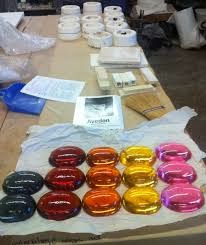
One of the uses of cullet (small pieces of glass) is in casting. However, simply placing the glass into a mould and firing, leaves many bubbles and often shows the edges of the original pieces of glass. Billets (ingots of glass) are more useful because they have fewer of the small bubbles and fewer edges than cullet.

It is possible to make your own billets. This can be done in a fashion similar to pot melts, although the temperature does not have to be so high. And the results are easy to store, if the dimensions are kept regular.


You need to have a mould for the melting glass to be contained within. These moulds can be made from plaster. A simple way is to use old margarine tubs placed upside down and fastened to the base within a dammed area. Pour the plaster of paris over the tubs to make the moulds. An alternative is to use strips of refractory material (fibre board or cut up kiln shelves) surrounded by heavy bricks to stop any movement due to the weight of the glass.


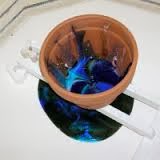
The glass to be formed is put into ceramic flower pots and can be directly onto the plaster of paris or dammed areas. You should put at least one piece of glass to cover the hole at the bottom of the pot. All this glass must be clean. Calculate the amount of glass required by determining the volume of the containment area (in cubic centimetres) and multiply by the specific gravity to give the number of grams required.


Don't get too ambitious about size, as these billets need to be fitted into the mould reservoir for filling the mould. A small margarine tub is approximately 12 cm wide, 7 cm deep and 7 cm high. This is as large as required, and smaller may be better. If you are making your own from dams, something like 4 cm by 8cm by 2cm may be better. This size is convenient for filling a reservoir, and has the advantage of being able to compare the intensity of colour the different thicknesses will give to the casting.


Remember that the thicker you make the billets, the longer you have to anneal. So the annealing time of the billet may be the factor that determines time. A 2 cm billet will take at least 9 hours of annealing time; one of 4 cm will take 28 hours of annealing.


When setting up the kiln for making the billets, remember that in general the higher the reservoir above the billet mould, the fewer bubbles you will get in the billet, although you are confined by the height of the kiln. Although there still will be some bubbles, these will further reduce by the second flow of the glass during the casting process.


To fire the set up, you can advance the temperature rapidly to 650/670ÂșC with a long soak there (possibly 3 hours). The final temperature can be below pot melt temperatures, so a casting temperature of 830ÂșC with a long soak (possibly 6 hours) will be sufficient. Take note of your final thickness – including any containment material – to determine the annealing soak and schedule.


Wednesday, 9 April 2014

Writing Your Own Schedules


Most introductory kilns are now being supplied with pre-set schedules. This can make moving on to the schedules you need for the new work you are doing appear to be difficult.

The first thing is to get the print-out of the pre-programmed schedules and determine what each stage of the programme is designed to achieve. If you compare the programme temperatures with a description of what is happening with the glass at that temperature, you will be going a significant distance to making your own schedule with an understanding of what you will be achieving with each stage of your purpose made schedule. A very good guide to what is happening to glass at various temperatures is this note from Bullseye. This also has the advantage of telling you what happens with different thicknesses of glass.

Next compare the pre-programmed schedules with those printed on the manufacturer's website, for example:

So, now you know what temperatures you are trying to achieve, how fast should you go to get to that temperature? I have developed a guideline that the initial rate of advance should be no more than twice the rate of your initial cooling rate for the final piece. This means that you start planning the schedule from the annealing portion of the full schedule. If you will have a final flat thickness of 6mm, the annealing rate will be around 80ÂșC, so the initial heat up rate could be about 160ÂșC. This is a conservative rate, and experience will guide you to how much quicker you can heat up the glass. This initial heating phase can be all the way up to the bubble squeeze/ slumping temperature, but must be to a temperature at least 40ÂșC above the annealing point.

There are at least three elements that will reduce this initial rate to less than this general guidance: Thicker pieces need more care. The more layers, the more difficult it is to get the heat to the bottom layer, so slower rates of advance are needed. The greater the unevenness in thickness, the slower the rate of advance.

There are, of course many other variables relating to the kiln, some of which are:
Side or top elements
Distance to the elements – side or top
Distance to the sides of the kiln
Placement in the kiln – e.g.,floor or shelf and how high
Nature of the firing surface – e.g., ceramic, fibre board, fibre paper
Placing in relation to the hot and cool spots in the kiln
How the glass is supported - especially on a slump or drape

At the initial stages of learning about fusing schedules, you need to make notes of all these things (and the results) on your firing records so that you can refer back to get guidance on what rates of advance are acceptable for any given firing.

Part 2

Wednesday, 2 April 2014

Glue Placement


Many people use glue to hold their arrangements of glass together to get it to the kiln. There are many kinds of glue that can be used. It is best to avoid resin based adhesives, but most other kinds of glue can be used – including hair spray, lacquer, super glue, CMC and PVA in addition to the proprietary fusing glues. The cheapest with the fewest additives seem to get good results.


Remember the glue burns away long before the glass becomes sticky, so if the glass won't stay in place while you are assembling it, it won't in the kiln either. The glue is only to keep things together while being transported to the kiln.

But this note is about were to apply the glue you choose to use.

The glue should always be used in minimum amounts. If it is a strong water based glue, such as PVA, it can be diluted with water and still provide sufficient adhesion. The glue should be runny, not thick or a gel. Unless the adhesive is a spray, a small dot at the edge of the piece to be glued will be sufficient. Capillary action will draw enough glue under the piece to stick it to the base glass.

If you are spraying the adhesive, that should be done at the end of assembly, to avoid flooding the base glass with adhesive. It is often best when using these lacquer based adhesives to spray a small amount of liquid into a container and use tooth picks or other pointed implement to dot the lacquer at the edge of the pieces to be attached. This way you can glue as you assemble rather than waiting to the end.

Adhesive under the middle of a piece of glass is likely to give black marks and even large bubbles, as the combustion gasses cannot get out from under the glass. So always confine your glueing to the edges of the pieces. A dot at each end is all that is required.

Wednesday, 26 March 2014

Hangers for Sun Catchers


Unless you are using some manufactured system or a frame, the most frequent way to provide hanging points for copper foiled sun catchers is to create a loop from copper wire.

Hangers should originate in a solder bead that goes some way into the piece. The loop's tail should lie a significant distance into the solder line to ensure it does not pull the piece apart. If this is to remain invisible, some planning will be required to allow the small extra space between the foiled glass.


The loops for hanging a piece of any size should not be soldered to the perimeter foil without reference to the solder bead lines within the piece, as the adhesive and foil are insufficient to hold the weight without tearing.


Reinforcement of free hanging or projecting elements can be done by placing wire around the piece with a significant excess going along the perimeter in both directions. The supporting wire can go into the solder line, if it is a continuation of an edge of the free hanging piece.

An example of a piece that needs reinforcement around the wings to keep them firmly attached to the body


The strongest method of proving hangers is to wrap the wire around the whole perimeter of the piece. Choose easily bent copper wire. This will be pretty fine, but when soldered, will be strong enough support the whole piece.

The perimeter wire can also be concealed by edge cames

The hanger can be made by leaving a loop of wire free along the perimeter. This way you can hang from any convenient place on the perimeter. This loop can be made by a single 180 degree twist in the wire, or by bending a loop into the perimeter wire. In all cases you will need to tin the wire to blend it with the rest of the piece.

An example of wire running between the yellow and purple on the left and incorporated into the design

This perimeter wire can be simply butted at the start/finish of the wire. It could be overlapped, but this is unnecessary on any piece where this method is adequate for support. The start can be at the top or bottom, although I prefer the top, so the wire is continuous from loop to loop. The reason for continuing beyond the loops is to provide support to all the edges of the sun catcher.

Wednesday, 19 March 2014

Annealing - Effects of Chemistry


Affects of Chemistry on Annealing Point

The change in the transition temperature is affected by the rate of cooling; it is also affected by the chemistry - or composition - of the glass. The transition temperature in silicates (glass of various compositions) is related to the energy required to break and re-form covalent bonds in an amorphous (or random network) lattice of the tetrahedra form of the glass molecules.

A covalent bond is one that involves the sharing of electron pairs between atoms. The stable balance of attractive and repulsive forces between atoms when they share electrons is what covalent bonding refers to.

The transition temperature is influenced by the chemistry of the glass. For example, addition of elements such as Boron, Sodium, Potassium or Calcium to a silica glass helps in breaking up the network structure, thus reducing the transition temperature and the melting temperature. Alternatively, Phosphorus helps to reinforce an ordered lattice, and thus increases the transition temperature.

The modifiers commonly used in glass-making are: sodium oxide, potassium oxide, lithium oxide, calcium oxide, magnesium oxide, and Lead oxide. Although there are over 2,000 known additives to glass. The minerals used to colour the glass seem to have minor affects upon the glass composition as they generally are in a colloidal suspension without forming bonds to the silica atoms.

If an oxide, such as sodium oxide, is added to silica glass, a bond in the network is broken and the relatively mobile sodium ion becomes a part of the structure. With increase in the amount of modifier, the average number of oxygen-silicon bonds forming bridges between silicon atoms decreases. The principal effect of a modifier is to lower the melting and working temperature by decreasing the viscosity. An excess of modifier can make the structural units in the melt sufficiently simple and mobile that devitrification (crystallization) occurs in preference to the formation of a glass. The skills of the glass makers lie in the balance of factors relating to the transition and working temperatures, and the maintaining the resistance to devitrification.

Reference: http://glassproperties.com