Tuesday, 15 January 2013

Air Brushing on Glass

Raphael Schnepf Workshop

Air brushing onto glass is a little different than onto other slightly absorbent surfaces. As glass cannot absorb the moisture from the material being sprayed, the medium needs to be allowed evaporate. This means that each layer of paint must be allowed to dry before the next layer is applied. If too much liquid is applied to the glass, it will bead up giving a stippled appearance to the finished result.

There are some things that can help to give an even application of the paint or enamels to the glass.

Clean the glass very well. After thorough cleaning and drying, use some of the paint to rub the glass. As the paint is a slight abrasive, it cleans off anything the other cleaning methods could not get off.

Add a drop of washing up liquid to the mixture of paint and medium (liquid). This breaks the surface tension of the medium and reduces the tendency to bead up on the glass.

Use alcohol part or all of the medium. This reduces the evaporation time. Also apply in a warm rather than cold place. You can use a hair dryer on low speed and power to assist the drying.

Apply in thin even layers, allowing the paint to dry between applications.

Open the air brush trigger before reaching the edge of the area to be painted and close it after reaching the other edge. Any overspray can be cleaned up as in any other painting.

A slightly larger opening at the nozzle is required on the air brush than for other paints, but you have to be careful to avoid opening it so large that you get the spitting of large drops of paint onto your surface.

Because you are putting very small particles into the air you need to observe various precautions. You need to have a dust mask on at all times you are air brushing. You should do this in a spray booth with extraction if possible. If not, you need a well-ventilated area and very good clean up afterwards.

Thursday, 10 January 2013

Avoiding Large Bubbles


I tried small projects and they turned out fine. I have a 12" square with an emblem in the centre and a border set in slightly from the sides. Most of the glass is only the one layer. Both firings produced huge bubbles in the areas where the glass was only one thickness.”

Scale does matter. What can be done at a small scale does not always transfer to a larger scale without alteration.


The first problem this project created was using only one layer as the base. Glass has a surface tension which means that it tries to become 6-7 mm thick, which is twice the thickness of a single layer. As it thickens at the edges, it traps the air under other parts of the glass, and as the glass continues to soften the expanding air bubbles come up through the thin parts of the glass.  Using two layers of glass with the design on top will ease the problem.


The design is the second problem. The weight of the border makes it even more difficult for the air to get out from under the glass.  Although having two layers of glass will reduce the problem, think about ways to make the border incorporated with the second layer of glass, so the weight of the glass at the perimeter is not greater than the interior.


The third problem is that there is not a bubble squeeze in the schedule (indicated elsewhere in the query). The soak of 10 minutes at 538ºC/1000ºF is not necessary. You do need a soak at a point between 620ºC/1148ºF and 677ºC/1250ºF - this is the bubble squeeze temperature range. It is also the slump temperature, so you can determine what the bubble squeeze should be for your glass by what the upper slump temperature is.


The bubble squeeze can be accomplished by a half hour soak at the slump temperature, or by a slow rise from 50C below the slump temperature – taking an hour or so, depending on the size of the piece.


A fourth problem is the that the separator is kiln wash, and the edges of the glass conformed to the kiln wash, resisting the movement of air from under the glass.


You may need to change to fibre paper for single layer pieces, as that allows more air out. Shelf paper may be enough, but you can also put it over 0.5 mm fibre paper for greater air release. Alternatively, sprinkle powdered kiln wash over the fibre paper and smooth it if you don't want to use Thinfire.


Lastly, try to avoid the factory set schedules in your kiln's controller, as they are generally set for 6mm thick pieces.


Look at the glass manufacturer's website. Bullseye, Spectrum, Uroboros, and Wissmach give basic firing schedules that work with minimal adjustment. I don't understand why kin manufacturers don't simply refer to the manufacturers’ sites to give their customers good advice, instead of the pre-programmed stuff.

Saturday, 5 January 2013

Orientation of Cutter Heads


In addition to the alignment of the cutter, you need to be sure you are moving the cutter forward in the way it was designed. If you look at the cutter from the side you will see two things. The most obvious one is that the angles of the cutaway on the head are shallower at the front and steeper at the back. In addition if you look carefully, the axel for the wheel is slightly forward of the centre line of the whole cutter.

Cutters aligned to score to the left


So it does not matter where the fixing screw on the head is. It may be at the front or at the back. What matters is the cutaway at the back which allows the cutter to be used with a shallower angle, than if reversed. This is most obvious on wide cutter heads.

Cutters arranged to score to the right


Sunday, 30 December 2012

Repair of a Plastic Barrel Cutter


Generally, there are two parts that can break or be damaged – the wheel and the barrel.

Wheel
If the wheel is damaged or worn, you can replace the head. When considering that, look at the cost of the head and consider whether the small cost difference indicates you should buy a new cutter instead.

The most common damage is a flat spot on the wheel. You can check for this, immediately after dropping the cutter, by lightly moving the cutter across a smooth piece of glass. If you hear a regular ticking sound, the wheel is probably “flat spotted” and will need to be replaced.

A worn wheel is more difficult to detect and is also much less likely to occur. I have been using some of my cutters for 15 years without any sign of being worn.

Plastic barrel
Sometimes the plastic barrel cracks or breaks. This will mean that the oil in the cutter will leak out. So you can consider continuing to use the cutter without oil, or by dipping the head in an oil soaked bit of cotton wool or similar material before each cut.

If the break is at the threaded end and you want to continue to use the ball at the end for tapping purposes, you can glue the barrel back together with an epoxy resin. Make sure the pieces are free from oil. Then glue and allow to cure. After curing, sand down any excess resin to make the cutter comfortable to handle.

Then for additional strength you can wrap with dental floss or extremely fine wire. Start below the glued area and go to the end of the break and back again. You could coat this wrapping with epoxy again both to secure the wrapping and to further increase the strength.

Another solution is to cut the cracked end off and re-thread the remainder. It makes the cutter a little shorter, but will continue to hold oil and give good service.

Or, you could buy another cutter.


Tuesday, 25 December 2012

Gas Fired Kilns


Installing a Gas Fired Kiln

There are a number of considerations about the location of a gas kiln.

Air exchange
The kiln should be placed in an area where there is good air exchange. For a number of reasons, it is usually convenient to place the kiln near an outside wall – ventilation and canister storage are the two most important.

Ventilation
There should be a low level vent to the outside to allow air to rise for the use of the combusting gas. There needs to be high level vent for the gas to escape. Ideally a hood with powered extraction would be installed.

Space
As with any kiln, you need to have sufficient space around the kiln to avoid heating any flammable materials. In the case of a gas kiln you need to be careful to avoid storing any thing that might ignite above the kiln. You can put heat resistant materials around the kiln if desired.

Location and storage of gas canisters
The safest place to put the gas canisters is outside the building. This does mean going outside to turn the valve on the gas canister on and off. However this is the safest place, should any fire start in the building, because the fire brigade can find and remove it from the fire. This placing applies to both the in use canister and any other full or empty canisters.

Detectors
Finally, even with these precautions, you should install a carbon monoxide detector. Carbon monoxide has no smell and can overcome you very quickly. Even a few minutes of exposure can leave you feeling ill for days.  

Thursday, 20 December 2012

Paint and Cold Working

One of the difficult things in cold working is determining when it is time to move on to the next grit size.  You really cannot tell while the piece is wet, because the water disguises the minute scratches put into the glass by the grinding process.

After you have dried the piece, you can coat it with a white paint pen. It is not necessary to cover the piece completely in white pen.  The white marks will be taken away by the grinding to give evidence of where you have already ground the piece.


Piece prepared for the next stage of grinding

You must make sure the paint has completely dried, or it will wash off with the water used in the grinding.

I find I get best results from this "witness" by making the paint pen marks at right angles to the grinding direction.  When all traces of the paint have disappeared, you have thoroughly covered the piece with that grit size.  Being ever cautious, I tend to dry, paint and do a second pass at the same grit before going to the next finer grit.

Saturday, 15 December 2012

Cold Working Holes

If you have, or expose, holes while cold working a piece, you need to keep the glass waste from settling into them. Dry the piece and with a bar of hard soap rub over the area until the holes are filled with soap. Then polish off the excess with a cloth or paper towel. 

The filled hole in this piece is the white dot half way up on the right side


When finished cold working, you only need to wash out the soap, which is much easier than trying to get rid of powdered glass.


Based on comments from Cynthia Morgan, posting as Morganica

Monday, 10 December 2012

Diamond Quarries


Diamond quarry glazing appears to be simple. But because if its simplicity it must be both accurate and aesthetically pleasing. Diamond quarried windows look best if the individual pieces are taller than they are wide. The window also looks better if the lines forming the diamonds end in the corners of the window as it gives a pleasing wholeness.

Simple sketches to show the relative clutter of a 6x6 and a 4x4 pattern

You can try making a sketch and trying various options of numbers and angles. By this simple exercise, you can determine the amount of clutter (how many lines vs. how much glass shows) produced by various combinations. It is important that the proportions of your sketch should be the same as the that of the window for which you are designing. This sketching process lets you try out various numbers of quarries along the bottom and sides quickly as the lines do not have to be accurate. Once you have decided on a size that looks good on the sketch you can count up the number of divisions on the horizontal and vertical lines. This can then be translated into approximate sizes on the full sized cartoon.


Begin with the cut line cartoon. This seems obvious, but until you have measured the window and given the glazing and border leads allowance you are unable to design a damond quarry glazed window that will have its lines meeting the corners in the finished window.


Drawing the diagonals


Begin the designing process by drawing two diagonal lines from the corners of the panel to ensure the lines will finish in the corners. This will also determine the centre of the panel and show you the slope of the diagonals. If you have not already determined the size of the diamond quarries, you can try out different sizes of diamonds by drawing parallel lines to the diagonals. 

Centre point determined, trial sizes of quarry, and the sides divided

When you have a size you like, you can determine the number of diamonds horizontally and vertically across the panel. You need to measure the width and height – point to point – of the test diamond and divide the lengths of sides to determine the number of quarries up and across the window. 

In this example of a small window (380 mm x 280 mm), the quarry is about 50mm wide and 65 mm high.  The exact sizes are not too important.  Divide the length of the base and side lines to determine the number of divisions.  In this example it is five on the base and six on the side. To get the exact dimensions for the quarries, you can use the no-calculation method of dividing a line. [link]

The divisions are extended to the opposite vertical or horizontal line to provide points from which to draw the diagonals.

Lef to right diagonal lines drawn
In this example feint lines were drawn up and down across the panel.  This provides a check that the diagonals remain accurate.

Remaining diagonals drawn  and confirmed by horizontal and vertical check lines


Sometimes, however, the corner to corner diagonals are too steep or too shallow to make pleasing diamonds. Diamond quarries generally have slopes that fall in the range of 50 – 60 degrees (45 degrees gives square quarries and anything over 60 degrees gives such a narrow quarry as to be unplesant). In these cases you need to determine the approximate angle for the diamond shape before proceeding from the centre point. 

Centre found and test diagonal drawn
In this landscape format example the diamond is horizontal, but otherwise a suitable size, so the dimensions were taken of it to determine the number of quarries on each side.  In this case it was seven along the bottom and four along the side.

Normally a 55 degree angle is a suitable middle range slope for diamonds, so you can start with that to determine what number of pieces vertically and horizontally are appropriate.  

After marking off the equal number of spaces, you can determine which points will give you appropriately angled diagonals. 

Number of quarries determined and first diagonal drawn
It is important to count the same number of marks along on the base line as there are marks on the side.  You will see in the above picture - if you look closely - the effects of narrowing diamonds if you do not.
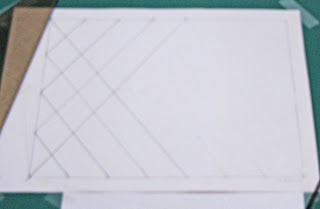
The second set of diagonals being added
After setting the diagonals on the first side and part of the base, continue with the parallel lines to the end.

Completed set of diagonals for a landscape window

This photo shows the completion of the diagonals.  It also shows the need for concentration.  I was interrupted and when I came back I drew a line from centre top to the next to last mark on the cartoon.  However, as you can see from the erasing, it should have been the corner mark that I drew to.  I point this out to emphasise how important it is to concentrate while doing this apparently simple task of joining the marks.

Wednesday, 5 December 2012

Dividing a Line

Dividing a Line into Equal Parts

There is a no-calculations method of dividing a line into equal parts. This describes how to divide a line into any number of equal parts without calculating and measuring the divisions.

The steps are:
Determine the number of divisions required across the base or perimeter line. Then draw a long line at a shallow angle to the line to be divided.

Angled line and dividers

Take a pair of dividers and open them to the approximate width of the individual division or piece.  In this example it was decided to have five divisions of about 50 mm.  The dividers are opened to 50 mm and marked off on the angled line from the corner the required number of times - in this case five.  

Then make a line from the last mark to the angled line to the end of the cartoon line with a right angle drawing square. 

Setting the angle

Place a long straight edge on the bottom of the drawing square and then mark the remaining divisions by maintaining the angle of the long straight edge while moving the drawing square from one mark to another. 

Moving the drawing square along the line and marking the base line


This process allows you to make equal divisions of a line without worrying about fractions of a centimetre or of an inch. It is simple and just as accurate as your skill in holding the straight edge steady while you run the drawing square along the edge and mark the base or vertical line.  In general it is more accurate than any calculations and measurements on the base or vertical lines.

Friday, 30 November 2012

Storing Moulds


Requirements

  • protection – some form of container is required to maintain the life of the mould. A container also prevents the kiln wash or other separator from being rubbed off.
  • ease of access – It should be easy to get to the moulds, especially as some can be heavy.
  • flat vs vertical – some like to store moulds in boxes vertically rather than horizontal with them stacked one above another.
  • In either case you need shelves of the right depth and height to store and support the moulds.
  • custom made vs bought in – Moulds you have purchased normally come in their own boxes which can be retained for storage for a number of years. You can also make light weight boxes either from old boxes or card cut to size and taped and glued together. More robust boxes can be made from thin plywood or thin pressed board.