Cut running pliers are intended to assist with the running of long straight or gently curving scores. Sometimes they are referred to simply as running pliers.
There are a wide variety of these made for different purposes. The following are illustrations of some of the styles.
To use these cut runners, you align the raised line on pliers with the line of the score and squeeze gently. The single line on the bottom jaw acts a fulcrum, allowing the two raised parts on the upper jaw to provide pressure to the score and run the break along the score line.
There are a wide variety of these made for different purposes. The following are illustrations of some of the styles.
 |
| This plastic cut runner is an economy version of the metal one below |
 |
| Metal cut running pliers |
The metal cut runners are pliers with curved jaws. When looking at the pliers from the nose toward the handles you will see the curve like a down turned mouth. These assist the breaking of the score by putting tension on the glass.
Cut running pliers almost always are supplied with covered jaws. This are normally two pockets of flexible plastic that fit snugly onto the slightly flared, curved jaws. Keep these on. When worn they can be replaced by buying more, or by wrapping the jaws with tape using "liquid plastic" or sometimes even using them bare.
There is a spacing screw on top which allows adjustment for different thickness of glass. It is intended that the jaws should not close completely – which can place excessive pressure on the glass – but be adjusted so that there is about 1mm less opening than the thickness of the glass. So when cutting 3mm glass there would be a 2 mm gap. On 4 mm glass the gap would be 3 mm, and so on. experience will show what relationship is best for you. The principle is that the pliers perform a gentle tensioning of the glass. Using your hands exerts more tension on the glass and cannot be so delicate.
Use
Align the centre of the top of the jaws - often the pliers have a centre line on the top to assist – along the direction of the score. Squeeze gently and the score will begin to run.
I have found my best success when using cut running pliers is to avoid trying to run the whole score from one end. With a bit of practice you get the feel for how much pressure you should be applying and so when to stop. Then turn the glass around and start the run from the other end. Usually the open ends of the score will meet and the break is completed. Occasionally the two runs will not meet. Then it depends on how complicated the curve is as to whether you use your hands to complete the break or start tapping the score line to finish the break.
More that one tool
There is a second variety of cut running pliers designed to run long scores near the edge of the glass. These can be used in the same way as the cut runners pictured above.
These cut runners made from plastic have a pad with a central raised point on the bottom jaw and a circular pad on the top jaw. Placing the point directly under the score line will begin running the score.
A more durable, but also more expensive version is the Silberschnitt cut runner.
The advantage of these is that the upper pad can be rotated to accommodate any angle, allowing shallow curves to be broken out. If progressively deeper curves are scored, this too can assist in breaking out deep inside curves.
This allows a score to be run gently over a long distance. This is especially advantageous when the score is a curving one.
Use
The upper pad is rotated so that it is at a right angle to the score. The lower pad has a point to act as the pressure point when the pliers are squeezed. As you move along the score, you continue to adjust the upper pad to maintain a right angle to the score. This is a much more gentle breaking action than the standard cut runners and runs the score in shorter distances. However these short runs make it more certain to run the score successfully.
Tools for Thick Glass
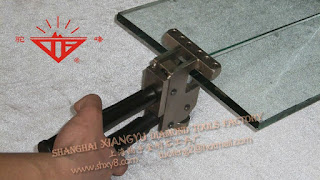
There are a variety of tools for breaking thick glass - usually 6mm and thicker. Some examples are illustrated.


These are used in the following fashion:
More that one tool
There is a second variety of cut running pliers designed to run long scores near the edge of the glass. These can be used in the same way as the cut runners pictured above.
 |
| The Ring Star cut runners |
A more durable, but also more expensive version is the Silberschnitt cut runner.
 |
| Moveable pad oriented to run scores in line with the pliers orientation |
The advantage of these is that the upper pad can be rotated to accommodate any angle, allowing shallow curves to be broken out. If progressively deeper curves are scored, this too can assist in breaking out deep inside curves.
 |
| Pad oriented at about 60 degrees for running score at an angle to the plier's orientation |
Use
The upper pad is rotated so that it is at a right angle to the score. The lower pad has a point to act as the pressure point when the pliers are squeezed. As you move along the score, you continue to adjust the upper pad to maintain a right angle to the score. This is a much more gentle breaking action than the standard cut runners and runs the score in shorter distances. However these short runs make it more certain to run the score successfully.
Tools for Thick Glass
There are a variety of tools for breaking thick glass - usually 6mm and thicker. Some examples are illustrated.

 |
| Note: these running pliers are pictured upside down. The two plastic pads should be on the top of the glass. |
These are used in the following fashion:

Adjusting cut running pliers for different thicknesses of glass.


