There are at least two major elements in choosing glass: density and clarity. A third is the “hot/cool” effect of colours. The appropriate combination of these elements leads to a panel with bright or hot spots where you want them. You can create a dramatic image or a more restrained one with more gradual gradations of light without obvious bright or dark areas.
Density
Density relates to the amount of light the glass allows through. Clearly black is the most dense glass – allowing no light through. In general, glass can be divided into opalescent and transparent.
Opalescent glasses range from the very dense opaque to less dense translucent glass.
Transparent glasses have a variety of densities too, although almost always less dense than opalescent glass. The density of transparent glasses relates to the intensity of the colour and the texture of the glass.
Colour intensity
The intensity of the colour is related to the amount of light allowed through. The intensity is directly related to the saturation of the colour. A further effect on colour intensity is the thickness of the glass. If you look at a handmade sheet of glass with different thickness on one end to another end, you can see the gradation of the colour and the amount of light that comes through.
Glass Textures
The texture of the glass affects the density of the glass. A smooth glass will have less density as the light passes through without dispersion. As the glass becomes more textured, the light is more dispersed and so appears more dense.
Tuesday, 28 September 2010

Friday, 24 September 2010
Glass Breaking While Soldering
Some report breaking pieces of glass while soldering. This may happen more on pieces that have big differences in width or taper to thin points. What is happening is that the glass is being heated too much locally in relation to the rest of the piece.
The solution is to solder at a steady pace. This allows the solder to cool without transferring so much heat to the glass as to break it. Some recommend that you do not rest your soldering iron on the foil while soldering. However it is the solder which is the heat sink, so the effort of holding the iron above the foil is not really necessary if you move at a reasonable pace.
This means that you do not stop with the iron on the seam. It is best to solder in one continuous movement along the seam, leaving an even bead behind. Sometimes the bead is not even. This may be because of wider parts to the seam, or inadequate flux, or many other reasons. Do not try to repair this before going on to the rest of the seam as this builds up heat in the adjoining glass. Since glass cannot dissipate heat well, the glass breaks when the temperature differential between the hot and cold parts of the glass is too great. Instead, complete the soldering of the seam before coming back to it. This gives you time to decide why the bead is not as good as you want it to be. It also gives time for the heat to reduce and even out through the piece of glass.
As you become experienced you will find a pace that suits the kind of bead on the joint that you want to achieve. If the seam is too flat, slow your pace or increase the rate at which add the solder to the iron. If the seam has too big a bead, increase your pace or reduce the rate at which you feed the solder. It is also possible to consider other methods of soldering.
You also need consider the usual problems relating to cleanliness and insufficient flux. Sometimes the soldering iron is not hot enough, but you should notice this early as the solder will not be melting at its usual rate and will be grainy in appearance.
The solution is to solder at a steady pace. This allows the solder to cool without transferring so much heat to the glass as to break it. Some recommend that you do not rest your soldering iron on the foil while soldering. However it is the solder which is the heat sink, so the effort of holding the iron above the foil is not really necessary if you move at a reasonable pace.
This means that you do not stop with the iron on the seam. It is best to solder in one continuous movement along the seam, leaving an even bead behind. Sometimes the bead is not even. This may be because of wider parts to the seam, or inadequate flux, or many other reasons. Do not try to repair this before going on to the rest of the seam as this builds up heat in the adjoining glass. Since glass cannot dissipate heat well, the glass breaks when the temperature differential between the hot and cold parts of the glass is too great. Instead, complete the soldering of the seam before coming back to it. This gives you time to decide why the bead is not as good as you want it to be. It also gives time for the heat to reduce and even out through the piece of glass.
As you become experienced you will find a pace that suits the kind of bead on the joint that you want to achieve. If the seam is too flat, slow your pace or increase the rate at which add the solder to the iron. If the seam has too big a bead, increase your pace or reduce the rate at which you feed the solder. It is also possible to consider other methods of soldering.
You also need consider the usual problems relating to cleanliness and insufficient flux. Sometimes the soldering iron is not hot enough, but you should notice this early as the solder will not be melting at its usual rate and will be grainy in appearance.
Monday, 20 September 2010
Temperature Rise Rates
I am always concerned when people recommend soaks on the way up in order to equalise temperatures. If the soak is required because the ramp rate is too fast, there are breakages going to happen sometime - maybe not now, maybe not tomorrow, but certainly sometime. If you need that extra time, add it into the schedule. E.g., a ramp rate of 200C from 20C to 520C with a 20 min soak could also be written as 176C/hr from 20C to 520C - both take 2.833 hours to achieve the same temperature. A controlled heating rate is preferable to one or more rapid rates with soaks.
I am also concerned about very rapid temperature rises after the bubble squeeze. The controllers often cannot adequately control such rapid rises. The rapid rise also often requires a higher target temperature to achieve the desired effect. This can mean that it is easier for bubbles - large and small - to form and rise to the surface during the overshoot of the target temperature. Temperature increases are about heat work - the combination of temperature and time. This means that you can achieve the desired result in two ways:
1- fast rise to high temperature or
2- Slow rise to lower temperature.
The second strategy may also require a longer soak at the target temperature than the one with a fast rise to a high temperature.
The aim in kiln work should be to achieve the effect you want at the lowest practical temperature. This is because glasses tend to change their characteristics more at higher temperatures than at lower temperatures.
I am also concerned about very rapid temperature rises after the bubble squeeze. The controllers often cannot adequately control such rapid rises. The rapid rise also often requires a higher target temperature to achieve the desired effect. This can mean that it is easier for bubbles - large and small - to form and rise to the surface during the overshoot of the target temperature. Temperature increases are about heat work - the combination of temperature and time. This means that you can achieve the desired result in two ways:
1- fast rise to high temperature or
2- Slow rise to lower temperature.
The second strategy may also require a longer soak at the target temperature than the one with a fast rise to a high temperature.
The aim in kiln work should be to achieve the effect you want at the lowest practical temperature. This is because glasses tend to change their characteristics more at higher temperatures than at lower temperatures.
Saturday, 18 September 2010
Dams - Links to Tips
There are a number of tips on damming kiln formed glass scattered around the blog. This is an attempt to provide links to them.
Damming Options for Ovals
Description of Needling
Prevention of Needling
Damming Options for Irregular Shapes
How High Should the Dams Be?
Separators for Dams
Damming Options for Ovals
Description of Needling
Prevention of Needling
Damming Options for Irregular Shapes
How High Should the Dams Be?
Separators for Dams
Thursday, 16 September 2010
Releases between the Glass and the Dam
An alternative to fibre papers or kiln wash separators between the dam and the glass is to use iridised glass. This of course, only works on pieces with straight lines on the sides. If you place the iridised side toward the fibre paper, you will get a clean release with a minimum of texture. If you do decide to use iridised glass as the release, you must not use Thinfire. It will cause awful pitting in the iridised glass.
Sunday, 12 September 2010
Lining Dams
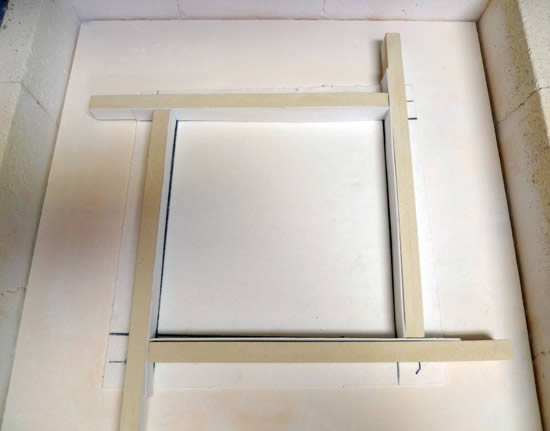
Dams should normally be lined with Thinfire and fibre paper to get the best release. If you are using fibre board that has not been hardened, you do not have to line, but you will get smoother edges if you do.
The lining papers should be about 3mm shorter than the expected final thickness of the finished panel. I find that 3mm paper against the dam provides the required standoff between the dam material and the glass. The lining of the fibre paper with Thinfire provides a smoother surface than just the fibre paper. Both of these liners should be the same height – 3mm less than the final height of the finished piece.
To calculate the expected final height you need to do a few calculations in the metric system. Weigh the glass in grams. Divide by specific gravity (2.5) to get the number of cubic centimeters. Divide the cc by the area enclosed by the dams in square centimeters. This will give the fraction or multiple of centimeters thick the glass is predicted to be.
Example:
The weight of glass = 500 gms
The specific gravity = 2.5
The area is 10cm by 10 cm = 100 square cm.
Divide 500gms (the weight) by 2.5 (the specific gravity) = 200 cubic centimeters. Divide 200 (the volume in cc) by 100 (the area) = 2 cm thick final piece for the amount of glass put into the pot.
This indicates the fibre paper should be 1.7cm high to allow enough space for the bullnose edge to form.
 |
| As described by Helios |
To calculate the expected final height you need to do a few calculations in the metric system. Weigh the glass in grams. Divide by specific gravity (2.5) to get the number of cubic centimeters. Divide the cc by the area enclosed by the dams in square centimeters. This will give the fraction or multiple of centimeters thick the glass is predicted to be.
Example:
The weight of glass = 500 gms
The specific gravity = 2.5
The area is 10cm by 10 cm = 100 square cm.
Divide 500gms (the weight) by 2.5 (the specific gravity) = 200 cubic centimeters. Divide 200 (the volume in cc) by 100 (the area) = 2 cm thick final piece for the amount of glass put into the pot.
This indicates the fibre paper should be 1.7cm high to allow enough space for the bullnose edge to form.
Wednesday, 8 September 2010
Height of Dams
Dams can be of any height available, but if it is easy to adjust the height, you should consider the ease of working with the glass inside the dams and the possibility of anything falling off the dams onto the glass.
The dam should be higher than the glass in its un-fired state. It should be high enough to contain the moving glass should anything go wrong, so it cannot be the same height as the fibre paper liners – those being 3mm shorter than the glass is high. As a rule of thumb, when I have the choice, I would make the dams at least 6mm higher than the unfired glass. This allows you to handle the sheets of glass and any components without having to reach over high walls. It also ensures containment should anything go wrong.
The dam should be higher than the glass in its un-fired state. It should be high enough to contain the moving glass should anything go wrong, so it cannot be the same height as the fibre paper liners – those being 3mm shorter than the glass is high. As a rule of thumb, when I have the choice, I would make the dams at least 6mm higher than the unfired glass. This allows you to handle the sheets of glass and any components without having to reach over high walls. It also ensures containment should anything go wrong.
Saturday, 4 September 2010
Damming Irregular Shapes
The assumption is that these pieces will be open-face thick fusings/castings rather than enclosed castings.
There are two basic types of dams: a shape cut from a single surrounding piece, or multiple pieces held in place.
Single piece dams
A large, thick fibre board with shape cut out will confine the glass. If very thick, you may need to weight the fibre board, as it is lighter than the glass.
Another variation is to use thick fibre paper cut out to shape and layered up to the desired height with stainless steel pins to hold the whole in place. This also may need to be weighted down. A variation on this is to place the whole on a fibre board and pin the layers of fibre paper into the fibre board to maintain the position of the fibre dams. This will not normally need weighting.
Multiple piece dams
If the shapes are not extreme, you can use pieces of fibre board or fibre paper backed up with kiln furniture, bits of broken kiln shelf or any other heavy material that will withstand the heat of fusing.
You can use thick fibre paper held in place with kiln furniture, if the piece is not thick. You do have to be careful that the glass does not float the fibre paper and run underneath, so about 10 mm is the maximum for this kind of damming. It also helps if this kind of dam is made larger than the glass – or alternatively the glass smaller than the dam. This allows the glass to flow out toward the dam, giving nice curved edges.
Moulds, stainless steel and other refractory materials can be specially made for shapes that will be repeated.
Note that all these variations will benefit from being lined with Thinfire backed up with fibre paper. This gives a smoother edge and also gives some cusioning between the dam and the glass.
There are two basic types of dams: a shape cut from a single surrounding piece, or multiple pieces held in place.
Single piece dams
A large, thick fibre board with shape cut out will confine the glass. If very thick, you may need to weight the fibre board, as it is lighter than the glass.
Another variation is to use thick fibre paper cut out to shape and layered up to the desired height with stainless steel pins to hold the whole in place. This also may need to be weighted down. A variation on this is to place the whole on a fibre board and pin the layers of fibre paper into the fibre board to maintain the position of the fibre dams. This will not normally need weighting.
Multiple piece dams
If the shapes are not extreme, you can use pieces of fibre board or fibre paper backed up with kiln furniture, bits of broken kiln shelf or any other heavy material that will withstand the heat of fusing.
You can use thick fibre paper held in place with kiln furniture, if the piece is not thick. You do have to be careful that the glass does not float the fibre paper and run underneath, so about 10 mm is the maximum for this kind of damming. It also helps if this kind of dam is made larger than the glass – or alternatively the glass smaller than the dam. This allows the glass to flow out toward the dam, giving nice curved edges.
Moulds, stainless steel and other refractory materials can be specially made for shapes that will be repeated.
Note that all these variations will benefit from being lined with Thinfire backed up with fibre paper. This gives a smoother edge and also gives some cusioning between the dam and the glass.
Subscribe to:
Posts (Atom)